Monday, March 27, 2017

1) Armed gang leader shot dead in Yapen, Papua


2) Family: Mikael Merani was unarmed when shot
3) Solomon Islands police to partner with Indonesia
4) Over 150 rebels surrender to Indonesian government in Papua
————————————————


http://www.antaranews.com/en/news/110166/armed-gang-leader-shot-dead-in-yapen-papua

1) Armed gang leader shot dead in Yapen, Papua

12 hours ago | 767 Views
Jayapura, Papua (ANTARA News) - Police have shot dead an armed law fugitive on the island of Yapen, Papua, after resisting arrest.

Maikel Marani, leader of a gang of armed criminals was killed after exchanges of fires in the village of Konti Unai in Yapen, Papua on Monday morning, police spokesman sr. comm Ahmad Kamal said by phone here. 

Police came to pick up Maikel Marani from his hidden place in the house of his parent in law.

"Maikel resisted and police have to shoot him," he said, adding, 

Maikel has been in the police list of "wanted men". 

Police found an old weapon and ammunition and the Bintang Kejora flag of the Papua separatists .

Papua is still a hot spot for Indonesia with separatist rebels hiding in the mountain jungles of the countrys easternmost and backward province.(*)

—————————————
A google translate. Be-aware google translate can be a but erratic.
Original bahasa link at
Senin, 27 Maret 2017 — 21:00
2) Family: Mikael Merani was unarmed when shot
Jubi | News Portal Papua No. 1,
Jayapura, Jubi - Monday (3/27/2017) morning, around 01:00 local time, Mikael Merani, a resident of Kampung Kontinuai, Angkaisera District, Yapen island district was shot dead by police officers Police Yapen. Mikael dead in-law's house.
 Head of Public Relations (Head of Public Relations) Papua Regional Police, Police Commissioner Ahmad Kamal acknowledged the shooting. Mikael named by police as a group leader who is often called an armed criminal (KKB). Area of ​​operations in the northern coastal region (north coast) and Yawakukat, Yapen Islands. Mikael is also mentioned on the wanted list (DPO) of the police.
"Had a clash in Konti Unai killing led KKB Maikel Marani," said Head of Public Relations quoted by Antara news agency.
This clash led Yapen Islands Police Chief Adjunct Senior Commissioner Suwandito Darma.
The police claimed to successfully mengamanankan evidence of the long-barreled senpi shoots types SS1, SS1 nine magazine, bayonet, vests, the Morning Star flag, 13 rounds of ammunition, a revolver, 10 rounds of ammunition caliber 5,56,229 rubber granules, 5.56 caliber ammunition, one bud wind guns and some money in the incident.
However, this statement is contradicted by the victim's family. According to the victim's family's initials MM-though circulated photographs holding a gun when his brother's body had fallen tertembak- brother was unarmed when the incident happened.
"Mikael is DPO. He was not armed when shot. He was at home in-law, were rounded up in the house, were taken out and shot. Cooking he kept weapons and other items in-law's house? "Said MM.
MM said, Mikael become DPO since three years ago for allegedly killing a policeman. However, the allegations could not be proven.

"During the DPO, he lived in Kontinuai. Why not arrested? He did not go anywhere, "said MM.
MM suspect, this has to do with the shooting of a conflict elections are taking place in Yapen.
"It was no conflict elections. There is already a victim of society. Yesterday also KPU office on fire. I suspect this has something to do with the conflict elections, "said MM. (*)

——————————————

3) Solomon Islands police to partner with Indonesia
3:43 pm on 27 March 2017 
According to the police minister of Solomon Islands, the country's police force is looking to enter a co-operation agreement with the Indonesian National Police.
Peter Shanel and other police ministers of Melanesian Spearhead Group member countries had a conference in Jakarta this month, following meetings of MSG police commissioners.

Melanesian Spearhead Group police ministers and police commissioners meeting in Jakarta, March 2017 Photo: Supplied
Mr Shanel told the Solomon Star that a draft Memorandum of Understanding between the Royal Solomon Islands Police Force and the Indonesian National Police was expected to be signed soon.
The draft MoU was focused on co-operation to prevent and combat transnational crimes and building international police capacity.
Mr Shanel signalled it would be timely for his country's police force, given that the Australian-led Regional Assistance Mission to Solomon Islands draws down its operations in July.
He said the Indonesian police will go back to their Foreign Ministry for approval before the signing will take place.
The Solomon Islands Police Commissioner Matthew Varley chaired the MSG Police Commissioners' Conference in Jakarta.
He said the meeting was good for Solomon Islands to "again demonstrate how important it is to co-operate on the international stage".
He said he met with counterparts from Papua New Guinea, Fiji and Indonesia.
“We had meetings with those senior officers but were also able to discuss how we might speed up co-operation across the region on transnational crime, drugs, trafficking and things like terrorism as well as smuggling."

Melanesian Spearhead Group police ministers and police commissioners being feted in Jakarta. Photo: Supplied
He also said that part of the MOU that Solomons would negotiate with the Indonesian National Police would focus on how the two countries could exchange and swap intelligence and expertises.
Mr Varley said Indonesia had over the past 15 years been at the forefront of counter-terrorism in the South Pacific region.
"And indeed they have a lot of expertises in identifying and investigating terrorism and although we are safe here in Solomon Islands at the moment from that we still have a lot to learn from our friends in Indonesia and around MSG.
"I think we can benefit from their expertise," Mr Varley said.
He said these MoUs give them the flexibility to exchange intelligence on a particular group of terrorist or a particular crime type.
"It is not in any way giving permission for any other country to send police officers here to do operation policing business," Mr Varley explained.
The prime minister of Solomon Islands, Manasseh Sogavare, is yet to confirm the move to sign a MoU with Indonesia over police co-operation.
A release from his office on Friday said the meeting of MSG police heads agreed on the formation of a Working Group to develop a Regional Security Strategy.

Melanesian Spearhead Group police ministers and police commissioners pose for a photograph, surrounded by Indonesian police. Photo: Supplied
"This is in acknowledgement of the ever changing security landscape in the MSG region and the understanding that crime is the common enemy to police and law enforcement institutions in a 'borderless' environment.
“The meeting also acknowledged that in order to effectively address crime, policing has to be separated from politics to ensure policing activities operate in an 'unrestricted environment'."
————————————————
Note. It would appear from information received that the below story was a set up by the authorities and they were not OPM at all. 
Not unusual for similiar stories once or twice a year.
——————
4) Over 150 rebels surrender to Indonesian government in Papua
Source:Xinhua Published: 2017/3/24 20:39:57

A total of 154 guerrilla fighters in Papua province have surrendered to the Indonesian government, the Indonesian army said in a statement on Friday. 

The fighters were members of the Free Papua Movement which has long engaged in rebellion and sought diplomatic ways to separate from Indonesia. 

The surrender happened following a humanitarian approach undertaken by the Indonesia army. 

"Finally, the humanitarian approach has successfully led 154 members of the Free Papua Movement give up their insurgency," the statement said. 

In a ceremony in Puncak district, head of the district Wilem Wandik handed Indonesia's red-and-white flag to a representative of the rebels as a symbol of their return, it said. 

President Joko Widodo's administration has been trying to create equality in development across the archipelago country, including creating a uniform price for fuel and cement, building toll roads in Papua province to help spur economic growth. 

The Free Papua Movement frequently targeted civilians, soldiers and staff of a US mining company in the province, leaving dozens of casualties.
Posted in: ASIA-PACIFIC
——————————-

1) Papuan pawns


2) First novel tells it gracefully like it is

-----------------------------

1) Papuan pawns
In the March edition of Islands Business Magazine


————————————————
http://www.nzherald.co.nz/entertainment/news/article.cfm?c_id=1501119&objectid=11825021
2) First novel tells it gracefully like it is
By Dionne Christian , Dionne Christian
When young writer Bonnie Etherington showed one of her Massey University classmates a short story she'd written, the last thing she expected was to be told she was seriously disturbed and in need of help.
Etherington, now 27 but back then just 18, had written about a plane crash and described, matter-of-factly, what happens when a body decomposes in the jungle. Having spent her formative years in West Papua, Indonesia, she was simply telling it like it was. Or is.
She says death is all around in a developing nation where there's extremely limited access to clean water and basic sanitation, reliable food supplies, medicines and health services, structurally sound housing and, indeed, all the other municipal services we take for granted.
Etherington talks straightforwardly about having nothing but green beans to eat for days or watching as her mother, Pip, a nurse, cut gangrene away from the leg of a woman who'd rolled into a fire while sleeping one night.
"Burns are quite common and often go untreated so gangrene becomes a massive problem. Mum was cutting it away from this woman's leg and putting it into a bowl. Later, Dad washed the bowl out and put peanuts in it. We were traumatised to learn we'd been eating peanuts out of the gangrene bowl. "
Given the abundance of material, it's no surprise that Etherington, already an accomplished short story and award-winning travel writer, draws on childhood experiences in West Papua for her first novel.
The Earth Cries Out is about a Nelson family struggling with grief and guilt following a tragedy. To heal and atone, 8-year-old Ruth's father moves his family to Irian Jaya (the Indonesian province now known as West Papua) to build a hospital in a remote mountain village. Her dad's distracted and her mum doesn't want to be there so Ruth does what all children do and tries to adapt and make friends.
Etherington says the family is nothing like her own. Born in New Zealand, she moved with her mum, dad Paul, and sisters to Bandung, Java when she was 2 then on to West Papua. Every three or so years, her family would return to New Zealand for an extended stay of up to six months to rest and recuperate. They once lived in Darwin for three years when Pip got so sick that they needed a longer break.

Culture shock was as much a feature of Etherington's childhood as bouts of malaria or dengue fever. Her primary schooling was patchy; intermediate constant and secondary schooling at an international school of Papua's coast, where she met her husband, Josh Eastwood.
Although the family is different from Etherington's own the poverty, unrest and death shot through the book are real. But it's not a grisly story - if anything, it's more visceral because of her understated but graceful style. Ruth's story is told sensitively and alternates with vignettes about Papua's flora and fauna.
Each is organised around a specific plant, such as an orchid or a breadfruit tree, accompanied by a short story. It's a skilful way of including information about the region's politics, history and peoples without putting far too grown-up words and thoughts into Ruth's mouth and brain.
The book's title comes from Romans 8:22: "We know that everything on the earth cries out with pain the same as a woman giving birth to a child." Acutely interested in environmental issues, Etherington says the novel is partly about relationships between women, especially mothers and their daughters, and the shades of loss and pain as well as love that can colour those relationships.
"I wanted to combine these themes and show that even through pain, there is hope. The novel also suggests that the earth itself, our environment, can feel and express pain."
West Papua has been occupied by Indonesia since the 1960s.
"It's our neighbour and we really should be more aware of it and it's not enough to know about where it is but we should be aware of what life is like there. The vignettes were my way of trying to get more stories of West Papua's people in, to show the multiplicities and go beyond the usual narratives of primitivism and cannibalism we usually read, because it's not like that at all."
Short-listed for the Commonwealth Short Story Prize in 2016, Etherington studied for a Master of Creative Writing at Massey University in Palmerston North. She credits senior lecturer and fellow author Dr Thom Conroy for encouraging her to include the vignettes about West Papua in the story.
Like most of her stories, The Earth Cries Out started when a character - in this case, Ruth - came to mind and wouldn't leave, but originally Etherington didn't plan to include as much about West Papua.
"I wanted to be a New Zealand writer so I thought I would have to have the story set mainly in New Zealand which, I suppose, was a bit ignorant of me. Thom Conroy encouraged me to keep those chapters. He said the story really came alive in West Papua."
Etherington is now Chicago-based, working towards a PhD at Northwestern University, focusing on tropical ecologies in Southeast Asian and Oceania literatures. She regards both New Zealand and West Papua as home but is reluctant to go into too much detail about the latter's political situation.
"I support dignity and justice for the people of West Papua and their lands. How that should best come about is not my place to say. It is the place of Papuans to say, whether that takes the shape of full political autonomy from Indonesia or some other configuration of reconciliation and reparations. I hope that their voices will be heard and respected."
The Earth Cries Out
by Bonnie Etherington
(Vintage, $38)

Saturday, March 25, 2017

1) Papua to get 5 percent, Luhut says on Freeport divestment


2) WHO appreciates Papua KPA for taking part in socializing prepex

————————————————————-


1) Papua to get 5 percent, Luhut says on Freeport divestment

Jakarta | Sat, March 25, 2017 | 07:50 am
Maritime Coordinating Minister Luhut Binsar Pandjaitan has said Papua will get 5 percent from the divestment of cooper and gold miner PT Freeport Indonesia, which is required by law to release 51 percent of their shares to the Indonesian entities.
Freeport divestment is part of what is being discussed by representatives of the government and Freeport Indonesia, a subsidiary of United States-based Freeport McMoRan, in connection with the conversion of the contract of work (CoW) into a special mining license (IUPK).
“With the divestment, we will have 51 percent of shares, while Freeport will have 49 percent, with 5 percent of shares for local administrations and for local tribes. With [the dividend from] the shares, Papua will improve its education, agriculture and livestock businesses,” Luhut said as reported bytempo.co on Friday.
He said the shares for Papuan people would never be tampered with and Freeport would pay the dividends to Papua. “It is part of the protection of our people in Papua,” he added.
When meeting with President Joko "Jokowi" Widodo on Wednesday, Papua Governor Lukas Enembe demanded 10 percent shares of Freeport.
Freeport Indonesia has refused to accept a government demand, and it converted its CoW into a special mining license (IUPK). The company argues that IUPK would effectively annul its CoW, signed in 1991. It has threatened to take the case to international arbitration if a mutual agreement is not met in the next few months. (bbn)
——————————————————-

2) WHO appreciates Papua KPA for taking part in socializing prepex
15 hours ago

Jayapura, Papua (ANTARA News) - The World Health Organization (WHO) expressed appreciation to the Papuas HIV/AIDS Eradication Commission (KPA) for being active in socializing adoption of circumcision using prepex in the province. 

Prepex is the Worlds Only Non-Surgical Male Circumcision Device.

Technical advisor of the Male Circumcision Innovation Group of WHO, Timothy Hargreave, said here on Saturday he came to Jayapura mainly to learn and see the use of Prepex in circumcision in a bid to prevent HIV.

"Papua is the first area in Asia adopting circumcision with prepex after Africa. Certainly there is difference . That is what we want to learn and know," Hargreave said. 

There must be differences in circumcision with prepex in Africa and Papua because of the need to adjust to situation and condition in each area, he added. 

"That is why we are here to learn and see. Hopefully the circumsion is safe for all both the patients, the officers and other involved," he said. 

He said he also appreciated the active participation of the local authorities in taking part in socializing circumcision with prepex in this province. 

He said, however, that circumcision does not guarantee that the the province would be 100 percent free from the HIV virus, therefore, he advised man to use condoms in having sex with prostitutes to minimize the spread of the HIV virus.(*)

————————————————

Friday, March 24, 2017

Photos of West Papuan supporters at "March in March" rally


Photos of West Papuan supporters at "March in March" rally


MARCH IN MARCH - STAND UP AUSTRALIA - 25 MARCH, 2017
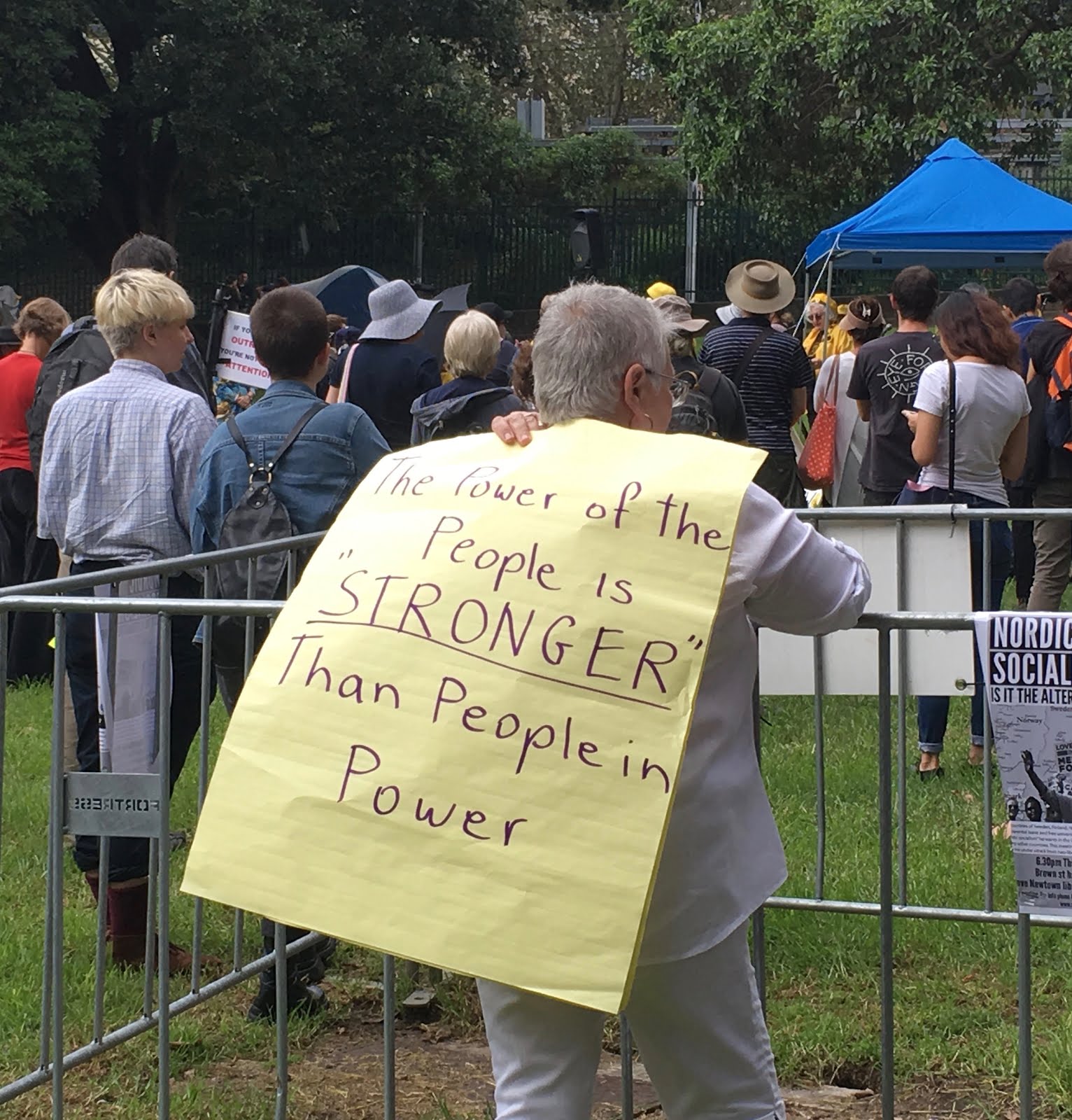
Protesters came out in Sydney today (25 March)  to send Malcolm Turnbull the people's message on all the issues of concern they have.
West Papuan supporters also joined in to fly the Morning Star flag and to raise awareness of the issue.

Video footage of march at Free Papua movement Australia Facebook page
https://www.facebook.com/FreePapuaMovementAustralia/


Photos below from Free Papua movement Australia Facebook page


Thursday, March 23, 2017

1) Man fined $500 for West Papua protest at Indonesian consulate

2) Indonesia urged to settle dispute amid Freeport workers’ outcry
3) Indonesia Wants Control of Freeport’s Grasberg Within Two Years
4) Freeport-McMoRan: New Twist At Grasberg
—————————————————————————————————-

1) Man fined $500 for West Papua protest at Indonesian consulate
Jane Lee MARCH 23 2017 - 3:18PM
A man is refusing to pay a $500 fine for trespassing at an Indonesian consulate to protest against its presence in West Papua, saying Australia has sold him out.
Tyrone Gibb, 42, climbed the fence at the Indonesian consulate in Melbourne, and up to the building's first-floor balcony on January 6. He waved a separatist "Morning Star" flag for the Indonesian province of West Papua, which is banned in Indonesia.
Gibb pleaded guilty to trespassing on a protected property at the Melbourne Magistrates Court on Thursday.
He was arrested and charged after the Indonesian government criticised Australian authorities for not doing so, almost a month after the protest was filmed and distributed on Facebook.
———————————————————-
2) Indonesia urged to settle dispute amid Freeport workers’ outcry
Jakarta | Thu, March 23, 2017 | 03:05 pm

Viriya P. Singgih The Jakarta Post


The demobilization process of workers of gold and copper miner PT Freeport Indonesia, a subsidiary of the United States-based mining giant Freeport McMoRan, that operates the Grasberg mine in Papua, the world's biggest gold mine and second-largest copper mine. (Courtesy of/The All Indonesia Labor Union’s (SPSI) local unit for PT Freeport Indonesia)


Gold and copper miner PT Freeport Indonesia (PTFI) employees have urged the government once again to immediately settle its dispute with the company as the number of laid-off workers has kept increasing from one day to another.
As of March 14, the company had laid off 2,102 contract workers, while giving long leave and offering voluntary resignation to 291 permanent staffers, according to the All Indonesia Labor Union’s (SPSI) local unit for PTFI, which represents around 12,000 PTFI workers.
The union also claims PTFI aims to dismiss 782 permanent staffers in the first phase of its efficiency measures.
“The company should discuss its efficiency measures together with the union so that both parties can reach a win-win solution,” Tri Puspital, an advocacy division member at the SPSI for PTFI, told The Jakarta Post on Wednesday.
Hence, he called on PTFI to stop such measures, while urging the government to immediately settle the dispute with the company.
PTFI was banned from exporting its copper concentrates on Jan. 12, when the government fully imposed the mineral export ban, as initially mandated in the 2009 Mining Law.
Under the new policy, PTFI can only process its export permit if it shows a commitment to converting its contract of work (CoW) into a special mining license (IUPK), divests 51 percent of its shares to local entities and build a new smelter alone or together with other companies. (bbn)
—————————————————————

3) Indonesia Wants Control of Freeport’s Grasberg Within Two Years
by Yoga Rusmana  and Eko Listiyorini

The dispute engulfing the world’s second-biggest copper mine deepened as Indonesia’s government said it planned to take a majority stake in the local unit of owner Freeport-McMoRan Inc. within two years while workers at the pit threatened to go on strike.
The state enterprises ministry has cleared a government-run company to buy a majority stake in PT Freeport Indonesia, the local unit that runs the massive Grasberg mine in Papua province, according to Fajar Harry Sampurno, the deputy minister for mining, media and strategic industries. Freeport-McMoran would have to divest its share to a state-owned entity under a new contract that the Phoenix-based miner is yet to sign.
“We’re ready,” Sampurno said at a press conference in Jakarta on Wednesday. A local aluminum producer, PT Indonesia Asahan Aluminium, will be turned into a holding company to purchase the stake, he said. “Once the holding company is formed, they will immediately work on it.”
The preparations for state-ownership suggest Jakarta is refusing to budge in a dispute that’s curtailed mining at Grasberg and prompted Freeport to lay off thousands of workers. Under new rules announced in January, the government said companies that want to export semi-processed metals including copper concentrate must convert their contract of work to a special mining license, build smelters and add local investors. Freeport has refused to do so until it gets guarantees protecting its investment.

Sell Shares

The rules stipulate foreign miners must begin selling shares to local entities five years after starting production and must reach 51 percent local ownership by the 10th year. Freeport must immediately divest its stake after converting its contract, because the firm has been mining in the country for more than a decade, Deputy Energy and Mineral Resources Minister Arcandra Tahar said in January. At present, Indonesia holds 9.36 percent of Freeport Indonesia.
The government last month issued a special mining license, or IUPK, to Freeport, but the company vowed to hold out for investment safeguards that provide the same level of fiscal and legal certainty as its current contract of work. The miner served a notice to Indonesia’s energy ministry in February over the areas of dispute, and said it has the right to begin arbitration if they aren’t settled within 120 days.

Company Talks

Freeport Indonesia continues talks with the Indonesian government, spokesman Riza Pratama said by text message on Wednesday. A senior government official said in early March that the administration wanted to resolve the standoff in two weeks.
Last month, Freeport Chief Executive Officer Richard Adkerson outlined the company’s concerns, decrying both the process for converting the contract to a license as well as the divestment requirement. “These forms of regulations are in effect a form of expropriation of our assets, and we are resisting it aggressively,” he said at a conference.
Indonesia Asahan Aluminium, known as Inalum, will be turned into a mining holding company to purchase the stake in Freeport’s unit, according to a presentation by the state enterprises ministry on Wednesday. Local miners PT Aneka Tambang, PT Bukit Asam and PT Timah will become units of Inalum.
Aneka Tambang, the state-owned nickel miner known as Antam, is ready to participate in the Freeport purchase, according to President Director Tedy Badrujaman.
“Antam, because of its expertise, will probably be assigned to monitor mining operations at Grasberg, especially during the transition period, if the stake purchase went through,” Badrujaman told reporters in Jakarta on Wednesday.

Union Demands

The Grasberg labor union is adding pressure on both sides to resolve the dispute and resume mining that’s been reduced to about 10 percent of capacity and resulted in about 2,100 workers to be laid off.
Workers will protest in seven days if the government and Freeport fail to respond positively to demands outlined in a March 21 notice, Tri Puspital, the industrial relations officer at Freeport Indonesia’s labor union, said by phone.
The union wants the government to form a tripartite body to protect workers’ rights and find a resolution that ensures future operations at the mine, he said. Freeport should stop laying off workers, according to Puspital.
“Workers will protest with a rally, and won’t rule out the possibility of a strike if there’s still no response,” he said.
————————————


4) Freeport-McMoRan: New Twist At Grasberg
Mar.23.17 | About: Freeport-McMoRan Inc. (FCX)

Vladimir Zernov  Long/short equity

Summary

The Indonesian government wants to take a majority stake in Freeport Indonesia in 2 years.
Papua administration also wants its piece of the pie.
Freeport-McMoRan should find a way to completely exit Indonesia with minimal damage.
The flow of news from Indonesia, where Freeport-McMoRan (NYSE:FCX) fights for its contractual rights with the local government, intensifies. This is typically a sign that we may hear some concrete information soon. Volatility in Freeport-McMoRan's shares may increase, providing opportunities for both longer-term investing and trading.
I previously covered this story, so in case you did not see it, you may find it useful to read previous articles (here and here) to learn more about the context. Without further ado, let's evaluate the recent news from Indonesia and what they might mean for the company and for the stock.
Bloomberg reported that the Indonesian government wanted to take a majority stake in Freeport Indonesia in two years. Preparations for this action have already begun by turning aluminium producer PT Indonesia Asahan Aluminium into a holding company.
At the same time, the administration of Papua, where Grasberg is situated, expressed its desire to get a 10% share of divested shares of Freeport Indonesia. Papua officials commented that Indonesian president "completely agreed with our stance on Freeport" and that Papua and Jakarta were fighting for the same thing.
As I previously commented, this time Indonesia is serious about getting its hands on Grasberg. In this light, all that Freeport-McMoRan can do is to maximize the value of its exit from Indonesia.
When the new part of the Indonesia story began, I was thinking that Freeport-McMoRan should find a way to minimize the damage and to continue operations at Grasberg. Now, it looks like the exit from Grasberg is almost inevitable and the only question is the price.
The reason for this is that Freeport-McMoRan cannot stay with a minority stake in the project as this will be a strategic suicide. The Indonesian government has already shown its inclination to change rules on the fly.
————————————————-