Thursday, July 26, 2018

1) Fijian Delegation For Indonesia Meeting


2) Indonesia participates in exercise in Australia

-----------------------------------------------

1) Fijian Delegation For Indonesia Meeting
by Parliament of Fiji
July 26 11:00 2018 
A Parliament delega­tion is in the Repub­lic of Indonesia for the Indonesia-Pacific Par­liamentary Partnership (IPPP) meeting on Human Development and Maritime Sustainability.
Led by the Speaker Dr Jiko Luveni, the meeting is aimed at strengthening co-operation and partnership among neighbours in the Pacific as they face common geographical and global challenges of this century.
This co-operation and partnership is based on the principles of respect­ing the territorial integrity and sovereignty of States as enshrined in the Char­ter of the United Nations.
The meeting also recog­nises the strong historical relations that the people possess as well as the op­portunity to deepen people-to-people relations.
The meeting is attended by more than 80 Speakers and parliamentarians from the Republic of
Indonesia, Cook Islands, Fiji, Kiribati, Marshall Is­lands, Federated States of Micronesia, Nauru,
Palau, Papua New Guin­ea, Samoa, Solomon Is­lands, Tonga, Tuvalu, French Polynesia and New
Caledonia.
The Fijian delegation in­cludes the Assistant Minis­ter for Rural and Maritime Development and
National Disaster Manage­ment Joeli Cawaki and Op­position Member of Parlia­ment Mere Samisoni.
Source:Parliament of Fiji


----------------------------------


https://en.antaranews.com/news/116858/indonesia-participates-in-exercise-in-australia
2) Indonesia participates in exercise in Australia
Reporter:  

Kupang, E Nusa Tenggara (ANTARA News) - Indonesia has sent four of its US-made F-16 fighter jets to participate in the Exercise Pitch Black Royal Australia Air Force in Darwin, Australia.

"We have sent four F-16s to participate in the exercise," commander of the Indonesian Defense Forces (TNI) Marshal Hadi Tjahjanto told newsmen here on Wednesday.

He was at the El Tari airbase here for an hour before departing to Australia for a high-level meeting.

"I am travelling to Australia not because of the exercise but to attend a high-level meeting, which is an annual meeting between Indonesia and Australia," he remarked.

Various issues from logistics to personnel, intelligence, and other security-related matters would be discussed at the meeting.

Regarding the two-yearly exercise, he hoped Indonesian forces would gain good results.

A number of aircraft has already left for Darwin to prepare before being involved in the exercise on Monday, which is attended by 16 countries.

The four F-16s are from Squadron 3 at Iswahyudi airbase in Madiun, East Java.

Reported by Kornelis Aloysius Ileama Kaha
(H-YH/INE)
(T.SYS/B/KR-BSR/C/E002) 
Editor: Heru Purwanto
-----------------------

Wednesday, July 25, 2018

1) Indonesia Reaffirms Fiji Ties


2) PNG's West Sepik governor wants to boost cross-border trade
----------------------------------------


1) Indonesia Reaffirms Fiji Ties
by FONUA TALEI JAKARTA, INDONESIA
July 25 11:37 2018 

The Indonesian Government has reaffirmed its stance to continue economic co-operation with Fiji.
Speaking to 10 foreign journalists in Jakarta on Monday, Indonesian Vice Foreign Minister Abdurrahman Mohammad Fachir said co-operation in the blue economy was vital for maritime nations because of the similarities they shared as archipelagic countries.
The “Blue Economy” is an emerging concept which encourages better stewardship of our ocean or “blue” resources. 
It highlights, in particular, the close linkages between the ocean, climate change and the wellbeing of people.
Mr Fachir said infrastructure on land and between islands were pertinent and as a result the current Indonesian Government planned to build a total of 32 sea ports in the next five years.
“Every country has its own interests, but they have an effect on other countries. We continue to make ourselves central and united when we engage with others,” he said.
Ten journalists from Fiji, Bangladesh, India, Papua New Guinea, Sri Lanka and the Solomon Islands are part of the Journalist Visit Programme (JVP), which is organised by the Indonesian Ministry of Foreign Affairs.
The programme aims to connect the Indonesian people with other countries through exchange of information.
“The more your people know about our potential and the more our people know your potential there will be exchange and there will be benefits,” Mr Fachir told journalists at his Jakarta office.
“You are very instrumental in sharing information and delivering messages and we need your assistance to promote the exchange and connection between our people and the world.”
During the course of 10 days the group of journalists will visit different cities in Indonesia, including Labuan Bajo, Bali and Yogyakarta.

On Monday the group visited the Jakarta Smart City office and were shown an application of a smart city concept designed to optimise the use of information and communication technology (ICT) to control various resources in the city of Jakarta more effectively and efficiently.
Members of the group were told that the concept would lead to maximum public service, provided solutions to problems and supported sustainable development.
After the visit to the smart city the delegation paid a courtesy call on the deputy governor for culture and tourism affairs and the vice minister for foreign affairs.
The day ended with a visit to the Peacekeeping Centre of the Indonesian National Defence Forces, where journalists were briefed by the Deputy Commandant Colonel Aldrin Mongan.
The centre was established in 2007 after a request from the United Nations for Indonesia to be part of UN peacekeeping missions.
Colonel Mongan said so far this year Indonesia recorded two deaths among more than 33,000 soldiers on deployment to more than 30 missions. 
Edited by Epineri Vula


-----------------------------


2) PNG's West Sepik governor wants to boost cross-border trade

7:25 pm today 


The governor of Papua New Guinea's West Sepik province is seeking to boost agricultural trade with neighbouring Indonesia.
West Sepik abuts PNG's international border and hosts the main land access to Indonesia's Papua province, at Wutung on New Guinea's north coast.
PNG people frequently cross the border at Wutung to visit markets just inside Indonesia to buy a range of goods.
In comparison there's not a lot of trade coming the other way, said the provincial governor Tony Wouwou.
"We are trying to establish some things like cacao and vanilla going there, so we can get some of the cash back," said Mr Wouwou.
"But in the meantime, there's a lot of people from here, Papua New Guinea buying a lot of things from them, like groceries and food items, that's what's going on here.
Tony Wouwou said he hopes to visit Indonesia soon to talk with its government about co-operative ventures.
He said included in this was a proposal for Indonesia to take electricity from the planned Fried River copper and gold mine in his province.
A Chinese-owned company PanAust has lodged a special mining lease application for the Frieda River project.
A hydro-electric dam to generate the power required for the project is being considered as a source for power across the border.
---------------------

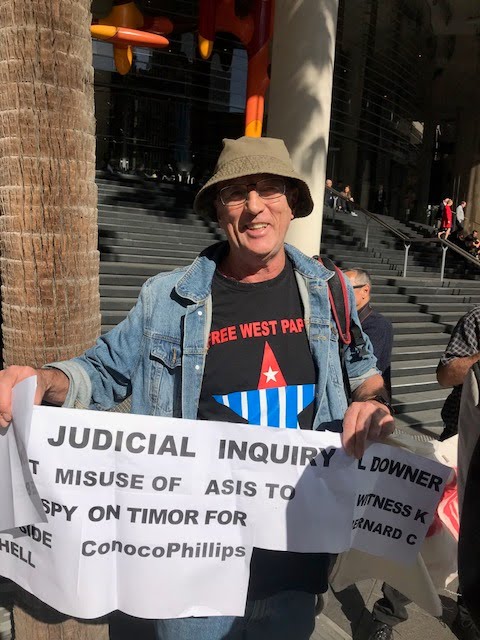
Photos -Rally in support of 'Witness K' and lawyer Bernard Collaery in Sydney


Rally in support of 'Witness K' and lawyer Bernard Collaery in Sydney


From GLW Facebook page
Pics from the Sydney protest against the prosecution of 'spy with a conscience' 'Witness K' and his lawyer Bernard Collaery outside the Commonwealth Offices in Sydney today. They allegedly revealed secret information about the Australian Secret Intelligence Service bugging cabinet rooms of the Timor Leste government during critical Timor Sea oil and gas negotiations in 2004. Photos by Peter Boyle for Green Left Weekly.
https://www.facebook.com/greenleftweekly/photos/ms.c.eJxFjskNwEAIxDqKOAfov7EokGW~;1hxmFXi6BCUBkId~;kMZaVXaAowFwQEhYqKQusE5Y7kbNKB0A7Urti85L7otJVywu~_CrK~_2LRlfAV407QNdUxrRWjMfUXeUcwVQ~-~-.bps.a.1326580510807138.1073742138.226910324107501/1326585270806662/?type=3&theater

----

Background

Human Rights Watch article

Australia: Don’t Prosecute for Exposure of Misconduct

Whistleblowing Former Spy, Lawyer Face Hearing for Revealing Bugging Operation

(Sydney) – Australian authorities should not prosecute a former Australian spy and his lawyer for exposing government wrongdoing, Human Rights Watch said today. The Magistrates Court in the Australian Capital Territory is scheduled to hold a hearing setting out next steps in the case against barrister Bernard Collaery and “Witness K” on July 25, 2018................


----------------------------------

Tuesday, July 24, 2018

1) Meet Tommy Suharto, son of a dictator turned democrat


2) Indonesia passes anti-terrorism law after suicide attacks on churches
-----------------------------------------
1) Meet Tommy Suharto, son of a dictator turned democrat
By James Massola & Karuni Rompies 24 July 2018 — 10:01am
Bogor: He has beaten corruption charges, spent time in jail for ordering the assassination of a Supreme Court judge, made a fortune that once ran to $US800 million ($1 billion) off the back of government concessions and grown up in the shadow of a nearly-all powerful father who ruled and shaped Indonesia for 31 years.
And now Hutomo Mandala Putra, much better known as Tommy Suharto,  wants Indonesians to vote for him.

The youngest son of Indonesia's longest-serving president, recently confirmed as a parliamentary candidate in Papua province for the April 2019 elections, has a new(ish) party machine, Berkarya, and has his sights set on winning 80 seats in the 575 member national parliament (they plan to stand a candidate in every seat).
Suharto told Fairfax Media on Monday that he had broken with Golkar, the party of his father and still a formidable machine in Indonesia's electoral politics, because "first of all, Golkar has moved away from its initial mission because they no longer put people's interest as priority".
"Instead, they fight more for the interest of the party elite and for power. In the end pragmatism is high so party ideology and character are no longer there," he said.
"Indonesia must become a strong agrarian country supported by strong industry. It means we should not only work to be self-sufficient, rather Indonesia, with such huge land, should become a world food barn [an exporter of food].

Like so many other candidates, Suharto's message is tightly-targeted one for the orang kecil, the so-called little people of this sprawling nation.
Both Indonesian President Joko "Jokowi" Widodo and the man considered most likely to challenge him again, the failed 2014 presidential candidate Prabowo Subianto, stress the need for food security, too -  a popular aspiration in Indonesia, where memories of the 2011 live cattle export ban imposed by Australia still linger.
But Suharto's dose of nationalism is measured with a dash of reassurance for an international audience wondering whether Australia's near neighbour might be about to turn further inward.
"I think Indonesia and Australia can co-operate because Indonesia has a huge need for meat, however we should have actual self-sufficiency in meat, especially beef, because we have a very big land. But cattle farming in Indonesia is not as good as in Australia," he said.

"So we should work together so that Indonesia can learn about the technology from Australia on how to run cattle farming."
Suharto's party has targeted 80 seats - one for each of the 80 electoral districts in the country - which amounts to about 13.9 per cent of the national vote, but "as a new party, it's quite challenging", he conceded.
In fact, according the Australian National University's Indonesia expert Associate Professor Marcus Mietzner, Suharto's new party could struggle to claim any seats in Parliament at all.
That's because to claim seats a party must also reach a threshold of four per cent of the national vote.
Mietzner said that was unlikely to happen because "he doesn’t connect with the electorate, he doesn’t connect with political elites and the electoral threshold is quite high this time".
Other "equally unappealling" potential candidates own TV stations or newspapers, Mietzner said.
"[Suharto] lacks all of that. He would have to do really well to win 40 seats, about half of what he wants."
Four per cent of perhaps 200 million registered voters is a tall order for any political party, Mietzner said, particularly one running candidates for Parliament for the first time, and in an environment where there is "no particular [president] Suharto nostalgia at the moment".
Under Indonesia's election laws, Suharto is not banned from running for Parliament because his corruption conviction was overturned.
And the prohibition on people convicted of crimes that carry a jail term of more than five years (he received 15 years but served about four for his role in ordering the murder of judge Syarifuddin Kartasasmita) also contains a get-out clause that lets people stand for Parliament if they are up front about their track record, according to the Jakarta Post.
Suharto has been famously litigious when the details of his past have been raised in the media.
He successfully sued national flag carrier, Garuda Indonesia, in 2011 after a translator for the English-language version of the airline's magazine added a footnote to an article about one of his resorts that noted his previous conviction.
Given his legal problems in the past, does this son of an autocrat-turned-democratic candidate support freedom of the press?
"Very much, that's why you are here, you are free to talk to me," he said with a laugh.

James Massola Facebook Twitter Google+ James Massola is south-east Asia correspondent, based in Jakarta. He was previously chief political correspondent for The Sydney Morning Herald and The Age, based in Canberra. He has been a Walkley and Quills finalist on three occasions.
------------------
2) Indonesia passes anti-terrorism law after suicide attacks on churches
Nithin Coca  July 24, 2018

5 Min Read

JAKARTA, Indonesia (RNS) — Weeks after a radicalized Muslim family committed suicide attacks on churches in the city of Surabaya, Indonesia, the country passed an anti-terror law meant to prevent more attacks and foster the majority-Muslim country’s tolerant culture.
The May 13 attack, which killed 13 churchgoers and a security officer and took place days before the start of Ramadan, was the deadliest terrorist attack in Indonesia since a 2002 bombing in Bali. Then, the target was foreign tourists. This time it was Indonesian Christians, a minority who make up about 10 percent of the population, according to the 2010 census. Many feared that the attacks were a sign that the country’s religious diversity is under threat.

“Indonesia prides itself on its tradition of moderation, but intolerance is growing in a way that is making some fear for their hard-won democracy,” said Sidney Jones, director of the Institute for Policy Analysis of Conflict, based in Jakarta.

President Joko “Jokowi” Widodo — a moderate Muslim who campaigned for the presidency with an image of a clean, populist politician — responded swiftly to the attacks, vowing a tough crackdown on terrorists. Key to that was his strong call for the passing of an anti-terror law.

“President Widodo promoted the importance of a stronger state capacity to respond to radicalism,” said Rafiqa Qurrata A’yun, a lecturer in the department of criminal law at the University of Indonesia. “One of his statement(s) in the media indicated the attacks were a result of the weak coercive power and preventive measures in countering terrorism.”

The anti-terror law expands the power of Indonesia’s military and police to take further actions against potential terrorists and those spreading radical ideology. Under the law, the Indonesian National Police can conduct pre-emptive arrests and detain people for being members of a group declared a terrorist organization. The law makes it an official offense to join a militant group overseas, such as the so-called Islamic State. It also expands the role of the Indonesian armed forces into domestic security.

In the weeks following Surabaya, government forces used their expanded power under the new bill to arrest dozens of suspected terrorists across the country. On June 22, Aman Abdurrahman, an Indonesian recruiter for the Islamic State, was sentenced to death for his role in inspiring the Surabaya bombers. The country last conducted a terror-related execution a decade ago. Days later, the police said they foiled two planned terrorist attacks, killing three suspects.So far, Jokowi’s crackdown seems to be working politically. In regional elections on June 26, after both the attacks and the passing of the bill, Jokowi’s coalition defeated Islamist candidates in four of the country’s five most populous provinces, putting him in a strong position ahead of presidential elections in April 2019. Jokowi enjoys strong support from many of Indonesia’s religious minorities, some of whom told Religion News Service that things are back to normal and that they feel safe attending church.

Jokowi has worked tirelessly to brandish his Islamic credentials while also tackling the rise of right-wing Islamism, which he has called anti-Indonesian. Last July, he issued a government regulation that expands the power of the Ministry of Law and Human Rights to disband groups that have ideologies deemed threats to national security and unity. The regulation was used to disband Hizbut Tahrir Indonesia, an organization with ties to the Islamic State.

The anti-terror bill was introduced in Parliament more than two years ago, after an attack in a Jakarta shopping area, but it stalled for various reasons, including concerns by human rights watchers that the bill could be used to suppress peaceful activists. Some human rights groups do not support the new law.

“It is obviously an overreaction to the Surabaya attacks,” said Andreas Harsono, Indonesia researcher for Human Rights Watch. “The quick deliberation … allowed a definition of terrorism that could be used to target peaceful political activities of indigenous groups, environmental advocates and religious or political organizations.”

The concerns are ones Indonesia knows only too well. It was just 20 years ago that the country became a democracy, after the strongman rule of Suharto, a general who was in power for more than three decades. Empowering the military and having a loose definition of terror could put too much power in the hands of those who perpetuated atrocities in the not-so-distant past, said Harsono.

“Indonesia has many areas with deep roots of violence and impunity,” said Harsono. “We still have not sought the truth of the 1965-66 massacres (nor what happened in) Aceh, Papua and East Timor.”
Others believe that the new law mostly addresses the concerns of human rights groups, but worry about its focus on security.

“The passed law seems to be more receptive to human rights principles compared to the first draft bill,” said Abdil Mughis Mudhoffir, a Ph.D. candidate in politics at the University of Melbourne’s Asia Institute. “Unfortunately, this new law still promotes the security approach that will not be effective and even counterproductive in addressing religious radicalism.”

For Jones, the key to reducing terrorist attacks in Indonesia and stemming rising intolerance will be the efficacy of deradicalization efforts, which need to be reformed due to the fact that women and children participated in the most recent attacks — something unprecedented in Indonesian history.“The Surabaya bombings may be a one-off horror, and we may not see family suicide bombers again anytime soon,” said Jones. “But they could also be a useful wake-up call to seriously evaluate existing programs to make them more effective by involving whole families.”
-----------------------------

1) 21 Papuan regencies receive MRP vaccines


2) Pacific countries need sustainable partnership: VP
3) Papua, Mimika must buy Freeport shares: Inalum
4) Waste Bank Kenambai Umbai started from a desire of clean city
-------------------------------------------------------

1) 21 Papuan regencies receive MRP vaccines
Nethy Dharma Somba
Jayapura | Mon, July 23, 2018 | 10:05 pm

Twenty-one out of 29 regencies and cities in Papua have received measles, rubela and polio (MRP) vaccines.
“The remaining eight regencies have yet to receive the vaccines,” Papua Health Agency vaccination division head Togu Sihombing said on Monday.
In addition to the measles and rubela vaccines, the government is also adding polio vaccines to the program because of a polio outbreak in neighboring Papua New Guinea (PNG).
Five regencies and cities in Papua -- Jayapura city, Keerom, Pegunungan Bintang, Boven Digul and Supiori -- share a border with PNG.
Togu said the agency had implemented the vaccination program dissemination in 26 regencies but not to the regencies of Yahukimo, Paniai and Central Memberamo.
“The three regencies have yet to implement the program dissemination because we are waiting for the right time,” he said.
 He revealed that 14 regencies have low vaccination coverage due to them being in remote areas and a lack of awareness among residents about the program.
Papua Customary Community Council deputy chairman Weynand Watoti suggested that the government should involve traditional leaders to increase residents’ awareness of the program.
“People still believe in customary and religious leaders. The campaign would be more effective if it involved them,” he said.
———————————————

2) Pacific countries need sustainable partnership: VP
Reporter:  

Jakarta (ANTARA News) - Countries in the Pacific region need strong and sustainable partnership with other countries including Indonesia, Vice President Jusuf Kalla said here on Monday.

"Countries in the Pacific region would not be able to overcome their challenges in human and maritime development sustainably by themselves," he said when speaking at Forum Indonesia Parliamentary Partnership (IPPP).

The first forum of meeting between the Indonesian parliament and those of countries in the Pacific region discussed "Human Development and Maritime Sustainability" .

It was attended by House Speaker Bambang Soesatyo, Deputy Speakers Fadli Zon, Agus Hermanto, Inter-Parliamentary Cooperation Agency chairperson Nurhayati Ali Assegaf and several other parliamentary members.

Speakers from the Pacific countries who attended the meeting include Wesley W. Simina from Micronesia, Jiko Luveni from Fiji, Tebuzi Uaai from Kiribati), Cyril Buraman from Nauru), Kenneth A. Kedi from Marshall Islands, Japsper Nasiu from Solomon Islands, Fatafehi Fakafanua from Tonga, Gaston Tong Sang from French Polynesia, John Simon from Papua New Guinea, Lecourieux Yoan from Caledonia.

Referring to the meaning of Pacific which is tranquil, Kalla hoped partnership between Indonesia and the Asia Pacific countries could give peace and tranquility for developing the region together to make it advanced.

"Many think the sea separates us while in fact the Pacific connects us and so problems being faced in the Pacific countries are similar," he said.

House speaker Bambang Soesatyo said when opening the forum that the meeting between Indonesia and countries in the Pacific region was part of Indonesia`s efforts to strengthen its diplomacy in the international forum as has been taken by President Joko Widodo to boost its role in the development of the Pacific region.

Reported by Riza Harahap
(H-YH)
(T.SYS/B/KR-BSR/B/E002) 
Editor: Heru Purwanto


---------------------------------------------

3) Papua, Mimika must buy Freeport shares: Inalum
Stefanno Reinard Sulaiman
Jakarta | Tue, July 24, 2018 | 09:30 am

The regional administrations of Papua province and the Mimika regency must purchase their 10 percent shares in gold and copper miner PT Freeport Indonesia (PTFI), which operates the Grasberg mine in Papua, state mining holding company PT Indonesia Asahan Aluminium (Inalum) has said.
But Inalum president director Budi Gunadi Sadikin has said Inalum would help the local administrations in obtaining loans and that they could pay the installment with dividends from PTFI.
“We will pay for all initial transactions and the installments will be from the dividends. However, if [the administrations] have the funds, there is no need for a loan,” Budi said on Monday.
The shares would be distributed to the Papua and Mimika administrations after the divestment process was completed and Inalum took control of 51 percent shares in PTFI.
In January, the central government signed a memorandum of understanding (MoU) with the Papua and Mimika administrations on distributing 10 percent shares of PTFI to the two local administrations.
The Finance Ministry has said that the funds to finance the 10 percent stake would use neither the state budget nor the regional budgets.
Meanwhile, during a meeting with the House of Representatives on Monday, it was revealed that Inalum and the Papua and Mimika administrations planned to establish a special purpose vehicle (SPV) to hold 25 percent shares of PTFI.
Inalum would hold 60 percent of the SPV, while the Papua and Mimika administrations would hold the other 40 percent. (bbn)
——————————————————

4) Waste Bank Kenambai Umbai started from a desire of clean city
Published
  
on


Sentani, Jubi – Wawa Farah, the Director of the Waste Bank ‘Kenambai Umbai’ where located in Jayapura District, has the fruit of the spirit to create a clean environment for Jayapura District and Jayapura City. It’s a reason she established a waste bank.
“I was touched and moved by the beauty of the land of Papua as featured in Edo Kondologit’s song, a little paradise that fell to the earth,” she said in Sentani on Saturday (21/7/2018).
She explained that each plastic waste has the different price, it goes approximately Rp 1,500 to Rp 2,500 per kilogram.
“The most expensive is a sort of mixed-type plastic such as cracked basin, whereas used plastic bottles are considerably cheaper between Rp 1,000 and Rp 1,500 per kilogram,” she said.
Meanwhile, Rina, a worker at the Waste Bank Kenambai Umbai, said workers are not only sorting out of the garbage but also going out around of Sentani City (Jayapura District) to collect used plastic bottles from kiosks or machine shops.
“Yesterday we had to go around the city to collect the garbage. We came to several machine shops to buy used oil bottles and some shops to collect the used mineral water bottles.” (*)
Reporter: Yance Wenda
Editor: Pipit Maizier
-------------------------------

Monday, July 23, 2018

1) Pacific regionalism, climate finance, and women in politics: in conversation with Hon Ralph Regenvanu

2) Students ask for Jokowi’s promises following an attack in Nduga

3) INDONESIA: Papuan human rights defender intimated and threatened by Yahukimo Regent’s campaign staff

4) Indonesia still has too much corruption, says Soeharto's son
5) Jayapura police arrest six escaped drug inmates
-------------------------------------------

http://www.devpolicy.org/pacific-regionalism-climate-finance-women-in-politics-conversation-hon-ralph-regenvanu-20180724/?print=print

DEVPOLICY Blog Published on July 23, 2018

1) Pacific regionalism, climate finance, and women in politics: in conversation with Hon Ralph Regenvanu

By Tess Newton Cain and Ralph Regenvanu

During a recent trip to Port Vila, Tess Newton Cain caught up with Hon Ralph Regenvanu, Minister for Foreign Affairs, International Cooperation and External Trade in the Vanuatu Government. Listen to a podcast of their conversation here, or read a transcript here. For the highlights of their discussion, read on…
Minister Regenvanu describes himself as a Port Vila citizen. He has lived for most of his life in the capital of Vanuatu, other than for a period of time when he was studying in Australia (he holds an Honors Degree in Anthropology and Development Studies from ANU).
He spent more than a decade as Director of the Vanuatu Cultural Centre, prior to a return to university in 2007, this time to study Law at the University of the South Pacific. Then his political career took off:
Halfway through my degree, I stood for election, and I got in at the end of 2008 as an independent candidate. And myself and the others who were with me in the political journey set up the Graon mo Jastis Pati in 2010.
This is Minister Regenvanu’s third term in Parliament and he has held a number of portfolios since 2008. He took over as Minister for Foreign Affairs in December 2017.
So, what are Vanuatu’s foreign policy priorities and what would he like to see his ministry achieve during his tenure as its leader? Significantly, the Minister points to internal matters as being more significant than external issues:
The biggest issues of this ministry are not so much external issues. The biggest issues of the Ministry of Foreign Affairs are the internal coordination of the government so that we can strategically approach our international relations and diplomacy. So, at the moment, it is quite difficult to effectively strategise about how Vanuatu places itself in the world, especially the most important thing for us on the horizon is the LDC graduation in 2020.
The minister explained that he thinks there are more opportunities for Vanuatu to work strategically bilaterally, regionally and globally. This is what will be required as the impacts of Least Developed Country (LDC) graduation take effect after 2020. Therefore, he is focused on getting the internal infrastructure right between his Ministry, the Prime Minister’s Office (which is responsible for aid coordination), the Ministry of Finance and Economic Management, and the Ministry of Agriculture, Livestock, Forestry, Fisheries and Biosecurity (which has carriage of the EDF11 program).
Politics in Vanuatu and voter behaviour tends to focus on the hyper-local issues so how can the work of the Foreign Minister and his Ministry be translated into messages that resonate with the urban voters of Port Vila, which is where Minister Regenvanu’s constituency sits?
…the best way to really make people appreciate our foreign relations is, of course, all the aid projects, right? And being able to show that they are well chosen, have high impact on the lives of people, that they’re conducted in a manner which is transparent, and they’re done efficiently. And that brings me back to what I originally said about being very strategic in how we organise ourselves internally to get projects, attract the right kind of projects and the right kind of conditions that we want.
The second aspect of foreign affairs that the Minister believes resonates with voters is one that is essentially part of the DNA of Vanuatu:
There is, of course, the very popular issue in Vanuatu of West Papua, and that’s also something which governments need to take heed of, in terms of the very, very popular support for the independence of West Papua in Vanuatu, which is translated into one of our foreign affairs objectives.
A third, emerging, narrative is around the growing awareness of the impacts of climate change in Vanuatu. On that note, we discussed recent statements the minister had made regarding climate finance and, in particular, the issue of compensation for loss and damage.
He expressed a certain amount of frustration with the actions (or lack thereof) of developed countries in relation to some key issues:
You’ve got to play the game that you yourself agreed to. So, when it comes to the Green Climate Fund, for example,… it’s a very poor effort by the developed countries who’ve said that they would contribute. Let alone, talking about loss and damage, which has absolutely no contributions, even though that was also an agreement made by all the countries…
I reminded the Minister he had previously expressed to me a degree of scepticism about the value of regional organisations such as the Pacific Islands Forum and the Pacific Islands Development Forum (PIDF). What are his current views on this?
I think the Pacific Islands Forum is definitely useful, especially in terms of articulating common positions and being a conduit for development finance, accessing larger facilities and so on… I can’t say the same about the MSG [Melanesian Spearhead Group]. I think the MSG is… it’s disappointing, to say the least and there’s a question of its relevance.
The Minister accepts that Vanuatu has a particular interest in the MSG, but says that ongoing support depends on management decisions made in the next little while. Whilst the decision on the membership application of the United Liberation Movement for West Papua is top of that list, there are other concerns around management of the organisation as well. As for the PIDF?
We’re currently not a member. And we’re just — I suppose we’re just watching it to see — we’re really more invested in the Forum at this stage.
Last, but not least, we turned to the issue of increased participation of women in political decision-making. This is an issue on which Minister Regenvanu has long been very vocal. Further to his contribution to getting temporary special measures included in municipal elections in Port Vila and Luganville, what is next in this space?
…the next step is going for political party legislation, which is what we’re working on now, to get a new bill through Parliament, which provides for the regulation of political parties. At the moment, we have nothing like that in Vanuatu. So, just a very simple law that says you have to register a political party according to certain criteria… And then in that legislation, I think, is room to create measures… by which women can get more representation.
Minister Regenvanu continues to be a prominent and influential member of the Vanuatu Parliament and Government. We will be watching his political progress with interest.
http://www.devpolicy.org/pacific-regionalism-climate-finance-women-in-politics-conversation-hon-ralph-regenvanu-20180724/

Date downloaded: July 24, 2018

—————————————————————

http://tabloidjubi.com/eng/students-ask-for-jokowis-promises-following-an-attack-in-nduga/
2) Students ask for Jokowi’s promises following an attack in Nduga
Published 17 hours ago on 23 July 2018By admin


Students joined the Solidarity for Nduga in a protest to refuse
military settlement in Nduga – Jubi/Doc
Dekai, Jubi – Dozens of students who are members of the Association of Students from the Papuan Central Highland 
of Indonesia (AMPTPI) urged the President Joko Widodo to solve some problems occurred following the attack by the
 military in Nduga on 11 July 2018.
Samuel Lokbere, the Chairman of the Student Association of Nduga said the conflict involved gunfire between the 
West Papuan liberation army and Indonesian security force has caused trauma for the local people in Nduga.
“Military operation in Alguru village is a real threat for civilians. Despite disturbing, it also increases the fear among
Nduga people who are still traumatic with the similar incident occurred in Mapenduma in 1995-1996,” Lokbere stated 
in a press release recently.
Meanwhile Efer Lokobal, the Chairman of AMPTPI Manado, North Sulawesi, also regretted the failure of the 
President Joko Widodo to fulfil his promise during his presidential campaign for solving the human rights issues in Papua.
“Until now the President of Indonesia failed to solve the human rights issues in Papua. Lately, even there are many 
shooting incidents against civilians everywhere.” (*)

Reporter: Piter Lokon
Editor: Pipit Maizier


------------------------------------------------
Note.AHRC makes it very easy to respond to their U/As

http://www.humanrights.asia/news/urgent-appeals/AHRC-UAC-040-2018

3) INDONESIA: Papuan human rights defender intimated and threatened by Yahukimo Regent’s campaign staff

  
July 18, 2018
ASIAN HUMAN RIGHTS COMMISSION - URGENT APPEALS PROGRAM
Urgent Appeal Case: AHRC-UAC-040-2018
send-button.gif
July 18, 2018
---------------------------------------------------------------------
INDONESIA: Papuan human rights defender intimated and threatened by Yahukimo Regent’s campaign staff

ISSUES: Human rights defenders, terror, intimidation, rule of law
---------------------------------------------------------------------
Dear Friends,

The Asian Human Rights Commission (AHRC) has received information regarding the terror and intimidation experienced by Mr. Theo Hesegem, a Papuan human rights defender. Prior to this intimidation, Theo advocated against the Yahukimo Regent’s abuse of power in unlawfully dismissing 199 village heads. While this has been reported to the authorities, no action is being taken.
CASE NARRATIVE:
On 25 June 2018, Mr. Theo Hesegem, a senior and credible human rights defender from Papua, was threatened and intimidated by the campaign team of the Regent of Yahukimo, Mr. Busop MA. According to Mr. Theo, the campaign team, a total of four people, came to Theo’s house. They came by two cars and parked in front of the house without any permission.
ahrc-uac-040-2018-01.pngWhen they reached the house, the four people suddenly shouted that they will kill Theo. Without enough evidence, they accused Theo of stealing money belonging to Air Garam village, Kurima district, Yahukimo regency. Although Theo said he does not know anything about the money, the four persons insisted that Theo has stolen the money.
According to Theo, this intimidation is related to his advocacy for 199 village heads who had been dismissed by the Regent of Yahukimo on 26 April 2018. Theo told the media that this dismissal violated Law No 6 of 2014. This provoked the Regent’s anger.
While Theo has communicated this problem to the Papuan governor and the Chief Police of Papuan Regional Police Office (Kapolda Papua), Police Inspector General Boy Rafli Amar, as of yet nothing has been done to address the problem.
ADDITIONAL INFORMATION
Theo Hesegem is a prominent human rights defender from Wamena, Papua. He is the coordinator of a local human rights organization in Wamena, and a consistent advocate against various human rights cases in Papua. Previously, the AHRC had issued an urgent appeal related to military intimidation against Theo: Papuan human rights defender insulted and intimidated by military command
SUGGESTED ACTION:
Please write to the authorities listed below. Ask them to ensure that the intimidation and death threats against Mr. Theo Hesegem must be stopped. The police and local government of Papua have to immediately address the problem. In addition, the police should investigate any form of terror and intimidation committed by the Yahukimo Regent’s campaign team.
The AHRC will write a separate letter to the UN Special Rapporteur on the Situation of Human Rights Defenders calling for his intervention in this matter.

To support this case, please click here: 
SAMPLE LETTER:
Dear ___________,
INDONESIA: Papuan human rights defender intimated and threatened by Yahukimo Regent campaign staff

Name of victims: Theo Hesegem

Names of alleged perpetrators: Yahukimo regent and his campaign team

Date of incidents: 25 June 2018

Place of incident: Papua
I am writing to voice my deep concern regarding the terror and intimidation experienced by Mr. Theo Hesegem, a Papuan human rights defender. Prior to this intimidation, Theo advocated against the Yahukimo Regent’s abuse of power in unlawfully dismissing 199 village heads. While this has been reported to the authorities, no action is being taken.
On 25 June 2018, Mr. Theo Hesegem, a senior and credible human rights defender from Papua, was threatened and intimidated by the campaign team of the Regent of Yahukimo, Mr. Busop MA. According to Mr. Theo, the campaign team, a total of four people, came to Theo’s house. They came by two cars and parked in front of the house without any permission.
When they reached the house, the four people suddenly shouted that they will kill Theo. Without enough evidence, they accused Theo of stealing money belonging to Air Garam village, Kurima district, Yahukimo regency. Although Theo said he does not know anything about the money, the four persons insisted that Theo has stolen the money.
According to Theo, this intimidation is related to his advocacy for 199 village heads who had been dismissed by the Regent of Yahukimo on 26 April 2018. Theo told the media that this dismissal violated Law No 6 of 2014. This provoked the Regent’s anger.
While Theo has communicated this problem to the Papuan governor and the Chief Police of Papuan Regional Police Office (Kapolda Papua), Police Inspector General Boy Rafli Amar, as of yet nothing has been done to address the problem.
Therefore, I respectfully request you to ensure that the intimidation and death threats against Mr. Theo Hesegem must be stopped. The police and local government of Papua have to immediately address the problem. In addition, the police should investigate any form of terror and intimidation committed by the Yahukimo Regent’s campaign team.

Yours Sincerely,
……………….
PLEASE SEND YOUR LETTERS TO:
1. Mr. Joko Widodo
President of the Republic of Indonesia
Jl. Veteran No. 16
Jakarta Pusat
INDONESIA
Tel: +62 21 3458 595
Fax: +62 21 3484 4759
E-mail: webmaster@setneg.go.id

2. Mr. Yasonna Laoly
Minister of Law and Human Rights
Jl. HR Rasuna Said Kav. 6–7
Kuningan, Jakarta 12940
INDONESIA
Tel: +62 21 525 3006, 525 3889
Fax: +62 21 525 3095

3. Dr. Mualimin Abdi SH., MH
Director General of Human Rights
Office of the Director General of Human Rights
Jl. HR Rasuna Said Kav. 6–7
Kuningan, Jakarta 12940
INDONESIA
Tel: +62 21 5253006
Fax: +62 21 5253095

4. General Pol. Drs. H.M. Tito Karnavian, M.A., Ph.D
Chief of National Police (KAPOLRI)
Jl. Trunojoyo No. 3 KebayoranBaru, Jakarta Selatan 12110
INDONESIA
Tel: +62 21 384 8537, 726 0306
Fax: +62 21 7220 669
E-mail: info@polri.go.id
5. Ms. Poengky Indarti
Commissioner of the National Police Commission
Jl. Tirtayasa VII No. 20
KebayoranBaru, Jakarta Selatan
INDONESIA
Tel: +62 21 739 2315
Fax: +62 21 739 2352
E-mail: secretariat@kompolnas.go.idskm@kompolnas.go.id

6. Professor. Amzulian Rifai S.H, LL.M, PhD
Chairperson of Ombudsman of Republic of Indonesia
Jl. HR. Rasuna Said Kav. C-19 Kuningan (GedungPengadilan TIPIKOR) Jakarta Selatan
INDONESIA
Tel: +62 21 52960894/95
Fax: +62 21-52960904/05
7. Mr. Kahar Muzakir
Chairperson of the Commission III of The House of Representative
Ketua Komisi III DPR RI
Gedung Nusantara II DPR RI, Lt I
JalanJenderalGatotSubroto, Jakarta,
INDONESIA
Telp : +62 21 -5715566, +62 21-5715569, +62 21-5715864
Fax : +62 21 5715566
8. H. Bambang Soesatyo, S.E., M.B.A
Chief of the Indonesian House of Representative
Gedung DPR/MPR RI
Jl. Gatot Subroto No. 6
Jakarta
INDONESIA
Tel: + 62 21 5715509; 5715344; 5715621
Fax: + 62 21 5714469, 5734389

9. Mr. Abdul Haris Semendawai
Chairperson of the Agency for Victims and Witness Protection
Lembaga Perlindungan Saksi dan Korban (LPSK)
Jalan Raya Bogor KM. 24 No. 47-49, Susukan, Ciracas, RT.6/RW.1, Susukan, Ciracas, Kota Jakarta Timur, Daerah Khusus Ibukota Jakarta 13750
Tel: +62 21 29681560
Fax: +62 21 29681551 / +62 21 29681557
10. Mr. Ahmad Taufan Damanik
Chairperson of the National Commission on Human Rights (Komnas HAM)
Jl. Latuharhary No. 4-B
Jakarta 10310
INDONESIA
Tel: +62 21 392 5227-30
Fax: +62 21 392 5227
E-mail: info@komnas.go.id
11. Inspector General Pol Boy Rafli Amar
The Chief of Police Area of Papua [KAPOLDA]
Jalan. Sam Ratulangi No. 8, Papua 99112
INDONESIA
Tel: +62 967 531014
Fax : +62 967 533763

Thank you.
Urgent Appeals Program
Asian Human Rights Commission (ua@ahrc.asia)
send-button.gif

Document Type :
Urgent Appeal Case
Document ID :
AHRC-UAC-040-2018
Countries :
    —————————————————————————————


4) Indonesia still has too much corruption, says Soeharto's son

Gayatri Suroyo and John Chalmers Reuters

Bogor, West Java, Indonesia | Mon, July 23, 2018 | 09:51 pm

The youngest son of former Indonesian President Soeharto, Hutomo "Tommy" Mandala Putra, said on Monday he is leading a party into elections next year because two decades of reform have failed to move the country on from corruption, collusion and nepotism.
"The Berkarya Party is here because, after 20 years of 'Reformasi', the truth is: it is not going in a better direction, there is no real plan for when Indonesia will become a developed nation," he said.
"That's why we are here to correct that," he told Reuters in a hotel outside Jakarta that he owns, adjacent to a motor racing circuit he promoted in the 1990s.
In response, Widodo's economic adviser, Ahmad Erani Yustika, told Reuters the administration had made some fundamental improvements in the economy, such as building new infrastructure and increasing food production for self-sufficiency.
President Soeharto, who ruled Indonesia with an iron fist for 32 years, was forced from office in 1998 as the world's fourth most populous nation descended into economic and social chaos.
Much of the blame for that crisis focused on the nepotism and corruption that became the hallmark of Soeharto's later years in power and which saw family members and close associates amass fortunes and come to dominate Indonesia's economy.
Tommy, a former racing driver with a playboy reputation who is now 56, was found guilty in 2000 of graft relating to a land deal in a verdict that was later overturned.
He was sentenced in 2002 to 15 years in jail for paying a hitman to gun down and kill the supreme court judge who had convicted him in the corruption case. His term was later reduced on appeal and by remissions, and he was released in 2007.
With no suggestion of irony, Soeharto said graft had remained a national scourge under President Joko Widodo, who is expected to seek a second term in next April's general election.
"At the start of 'Reformasi', people said we have to be free of corruption, collusion and nepotism, but now public officials are still caught red handed," he said.
Asked if he had any ambition to become president or vice-president himself, Tommy said his only aim was to secure as many of parliament's 575 seats as possible for his Berkarya (Working) Party, and he had set a target of 80. He himself plans to contest in the impoverished eastern province of Papua.
Changing Perceptions
Suharto family members have made repeated attempts in the past to get into politics, often seeking to tap into nostalgia about the unity and security under Suharto's government, which was backed by a military that crushed any sign of revolt.
Tommy said he would campaign on social media to change young voters' perceptions about his family.
"This negative perception is not correct because President Soeharto was never pronounced corrupt," he said, speaking on the sidelines of a party conference and, like all the delegates, dressed in Berkarya's signature colour, bright yellow.
"They said he was like Marcos and there are billions of dollars in Europe, etcetera. But after all the checks, there is no such money," he added, referring to former Philippine dictator Ferdinand Marcos.
Tommy said he had served a sentence for his conviction and now had the same right as any other citizen to enter politics.
He declined to put a figure on his net worth, repeatedly saying that the question should be put to the tax authorities.
Tommy, whose party has promised to make Indonesia self-sufficient in food, said there is not enough control over its farm industry.
He also criticised Widodo's government for "opening up its arms too widely" to Chinese investment without involving local contractors and workers.
——————————————
5) Jayapura police arrest six escaped drug inmates
Reporter:  


Jayapura, Papua (ANTARA News) - The Jayapura Police has again taken into custody six prisoners, who had escaped from the Doyo Baru Narcotics Prison in Wibu Sub-District, Jayapura District, Papua, on Sunday.

"We have arrested the six inmates from locations around Doyo and Sentani," Jayapura Police Chief Adjunct Senior Commissioner Victor Mackbon stated here on Monday.

The police had deployed 30 personnel at several locations, including the border area, Sentani airport, and Jayapura port, to help in the search of the inmates.

"The police and officials of the prison have continued to hunt down the inmates," he added.

He called on the families of the inmates to remain cooperative and share with the police any information on the whereabouts of the escaped prisoners.

Earlier, on Sunday, 31 inmates had broken out of the Doyo Baru Narcotics Prison in Wibu Sub-District, Jayapura District, Papua.

They broke the jail`s Cenderawasih 1.1 block by knocking down the trellis of the ventilation room and used it as a ladder to scale the jail`s wall.

A total of 31 prisoners escaped of which two were recaptured earlier.

"Until now, we continue to hunt them down around a forest in Sentani," an official of Doyo Baru prison Hernowo remarked.

Reported by Musa Abubar
(S022/INE)
(T.SYS/B/KR-BSR/C/F001) 


Editor: Heru Purwanto
-----------------------------