Friday, August 2, 2013

1) Indonesia relations: Three lessons from Timor


1) Indonesia relations: Three lessons from Timor
2) Freeport’s Grasberg Output May Fall 20% Short of 2013 Target
3) In Paniai, HIV-AIDS CASE TO REACH 761 
4) SUPPORTS GOVERNOR OF PAPUA EXAMINATION HIV in Paniai 

--------------------------------------------------------------------------------------------------------------------------
http://www.lowyinterpreter.org/post/2013/08/01/Indonesia-Three-lessons-from-Timor.aspx

1) Indonesia relations: Three lessons from Timor

by Iain Henry - 1 August 2013 10:29AM


Iain Henry is a Fulbright Scholar and PhD Candidate at ANU's Strategic and Defence Studies Centre. He tweets at @IainDHenry.

Recent events have thrust the Australia-Indonesia relationship back into the spotlight. Managing this relationship will be one of the next Government's highest priorities. Importantly, this extends beyond the immediate concern of people smuggling. Hugh White has recently argued that Indonesia will only become more important for Australia in the coming years, so it seems obvious that we cannot let a single issue dominate such a relationship.
In this context, the history of East Timor's independence provides a cautionary tale for Australia's political leaders.
Australia's role in East Timor still generates suspicion and resentment among some Indonesians. At worst, it is said Australia secretly worked to achieve East Timorese independence, despite havingassured Indonesia that we supported their rule. At best, Australia's conduct was seen as unnecessarily triumphalist and insensitive to Indonesia's fragile position following the fall of Suharto.
Within the last few years some commentators have suggested that Australia secretly worked towards East Timor's independence, but these claims do not withstand critical examination. In a recent article published by the Australian Journal of International Affairs (paywalled), I examine Australia's 'historic policy shift' on East Timor. Drawing on data from interviews with 15 former political leaders, public servants and others, I rebut the idea that Australia ever desired, or worked towards, East Timorese independence.
Once Indonesian President BJ Habibie had resolved to conduct an act of self-determination in East Timor, Australia had little choice but to support it. In allowing a self-determination ballot, Habibie had put Indonesia's international reputation on the line at a time when it desperately needed foreign assistance to recover from the Asian financial crisis. In this situation, Australia's neighbourly duty was to help as much as it could by ensuring a free and fair ballot.
Few Indonesians will ever see Australia's conduct in East Timor as the behaviour of a good neighbour, but the alternative — a ballot subverted or overturned by the Indonesian military — would have been a catastrophe for Indonesia's fledgling democratic experiment.
The history of 1998-1999 contains three important lessons for Australian leaders and policymakers today. The first is that sudden policy changes can have a significant impact on the bilateral relationship. When Prime Minister Howard wrote to BJ Habibie and suggested a policy change on East Timor, it sparked an unanticipated chain of events that led to East Timor's independence. This outcome could not have been reasonably foreseen, but the example shows that policy decisions regarding Indonesia must be handled with the utmost care, sensitivity and tact, lest they generate unintended consequences. Sadly, Australia's recent track record on this front is less than encouraging.
The second lesson is that, put simply, we need to treat Indonesia with much greater respect.
This is not to suggest that we refrain from pursuing our national interest or self-censor on issues of disagreement, but rather that we begin to treat Indonesia as an important country. We especially need to strive to ensure that we do not embroil Indonesia in our own domestic political squabbles. Following the tragic violence of September 1999, the myth that Australia 'liberated' East Timor was politically advantageous for the Howard Government, but it gave credence to the argument that Australia conspired to break up Indonesia.
The behaviour of our political leaders could go a long way to changing the national conception of Indonesia. This is a non-partisan point: both sides of politics are guilty of this sin.
Hopefully, as the Australian electorate becomes better informed about Indonesia's growing importance, public attitudes could shift to the extent that a prime minister's ability to manage the Indonesia relationship (much like their ability to manage the US alliance or our economic relationship with China) becomes a key test of their electability.
Thirdly, it is worth considering whether we are best served conceiving of Australia and Indonesia as 'friends' or as 'neighbours'. If we approximate the countries to two individuals, they would share few similarities: different standards of wealth and education, different languages, customs and culture. Their friendship, while not impossible, would seem unlikely. They would have little in common and would probably mix in different social circles.
Perhaps for these reasons, some find it hard to conceive of Australia and Indonesia being friends. However, these differences shouldn't prevent us from being good neighbours. Rather than both countries perceiving the other to be something of a fair-weather or unreliable friend, a more stable footing might be for both countries to focus on being a 'good neighbour' to the other. Good neighbours wouldn't construct a new fence, remove a shady tree or adopt a noisy dog without first discussing the idea with their neighbour.
Over time, once these habits of cooperation and consultation have become the norm, we might find that, because of our efforts to become good neighbours, we become good friends.
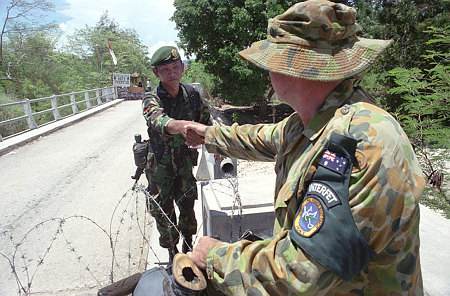
Photo courtesy of the Defence Deaprtment.


-------------------------------------------------------------------------------------------------------------------------------

http://www.thejakartaglobe.com/business/freeports-grasberg-output-may-fall-20-short-of-2013-target/

2) Freeport’s Grasberg Output May Fall 20% Short of 2013 Target

Freeport-McMoRan Copper & Gold Inc.’s (FCX) production at Grasberg in Indonesia, the world’s second-largest copper mine, may be 20 percent below this year’s target after a deadly tunnel accident in May suspended work.
Daily production at Grasberg, which has open-pit and underground facilities, is close to 80 percent to 90 percent of its normal rate, Rozik B. Soetjipto, president director at unit PT Freeport Indonesia, told reporters in Jakarta today. The underground mine may take some time to reach its capacity, he said.
Freeport had targeted output of 1.1 billion pounds of copper and 1.2 million ounces of gold this year, the company said today. The deposit, located in Papua province, normally produces 220,000 tons of ore a day.
Phoenix-based Freeport halted work for more than a month at Grasberg after a tunnel collapse on May 14 killed 28 workers. Shipments from the mine resumed last month after the Indonesian government allowed operations to restart.
The suspension at Grasberg affected production by about 125 million pounds of copper and 125,000 ounces of gold in the second quarter, the company said on July 23.
Indonesia’s government has been pushing metal mining companies in the country, including Freeport and Vale SA, to raise the royalties they pay to 10 percent, as part of negotiations to extend the companies’ mining contracts.
Freeport has agreed to raise royalties for copper to 4 percent from 3.5 percent, for gold to 3.75 percent from 1 percent, and for silver to 3.25 percent from 1 percent, Soetjipto said.
The government is also seeking higher state revenues from the mining industry by increasing domestic metals processing to lift the value of shipments. It plans to ban all mineral-ore exports starting from 2014.
Freeport will still be allowed to export concentrates in 2014 as the company is committed to developing domestic metal processing, Soetjipto said.
“I don’t expect that there will be a drastic decision by the government,” Soetjipto said. “And so far from our understanding, the government agrees to give us hopefully some time for us to still continue exporting our concentrate.”
Freeport exports about 60 percent of its concentrates and the rest of its output is processed at PT Smelting, Indonesia’s only copper smelter, he said.
Freeport will sign concentrate-supply agreements with three companies that plan to build smelters and is conducting a feasibility study to build a processing plant in the country, Soetjipto said. The smelters, which are expected to be completed by 2017, will need supplies of as much as 1.6 million tons of concentrates to produce a total of 500,000 tons of copper cathode, said Rudy Seba, Freeport’s Vice President of Technical Affairs.
Bloomberg
---------------------------------------------------------------------------------------
A google translate of article in MJubi. Be-aware google translate can be a bit erratic.
Original bahasa at


3) In Paniai, HIV-AIDS CASE TO REACH 761 
Author: Eveert Joumilena | 21:42
Editor: MUSA ABUBAR

| August 2, 2013 | 0


Paniai, 2/8 (Jubi) - Based on data from the Health Office (PHO) Paniai Regency, recorded since the year 2002 to 2013, found the number of cases of HIV / AIDS reached 761 cases.

This was stated by the Chief Medical Officer Paniai Regency, Robby Kayame told reporters in Enarotali, Pania, Friday (2/8). According to Robby, the estimated number of cases in Paniai, Paniai if wearing the population in 2012, which is 154 662 inhabitants.

"So in the case Panai estimate is 3,712 or 2 percent of cases multiplied by 154 662 people, while the discovery of cases since 2002 to 2013 has reached 761 cases, with this fact clearly in Paniai is lost or not yet found 82, 81 per cent of cases of HIV / AIDS is 2,951 souls , "said Robby Kayame.


He said, specific features will be clearly displayed on the report of treatment and care of HIV / AIDS hospitals Paniai, ie of the 638 cases during 2002 to 2012, 105 cases were new cases discovered in 2012.

"Furthermore, of the 108 cases, are eligible to start or be given ARV is 70 people (64.81 percent), but given or receive ARV of the 70 people only 36 people (51, 43 percent)," he explained.

Meanwhile, the Regent Paniai, Kayame Heng, said, regarding the condition of cases is increasing, thus becoming the main reason to encourage socialization and launch mass HIV testing to all people in Paniai.

"In addition to the aim of understanding and improving understanding of the umu masyarakata of antiretroviral drugs (ARVs), the other side of HIV / AIDS like disease - Other diseases that need to be taken regularly drug every day for life," he said. (Jubi / Eveerth)
--------------------------------------------------------------------------------------------
A google translate of article in MJubi. Be-aware google translate can be a bit erratic.
Original bahasa at

4) SUPPORTS GOVERNOR OF PAPUA EXAMINATION HIV in Paniai 
Author: Eveert Joumilena | 21:27
Editor: MUSA ABUBAR
64 Total Views
| August 2, 2013 | 0

Governor of Papua, Luke Enembe (Jubi / Alex)

Paniai, 2/8 (Jubi) - Governor of Papua, Luke Enembe support mass inspection HIV / AIDS conducted in Enarotali, Paniai Regency, which was attended by thousands of local residents, Thursday (1/8).

It is the Governor of Papua, Luke Enembe, in remarks read out the Chief Medical Officer in Papua, One Wakur, when opening the examination Launching Bulk HIV in Enarotali, Thursday (1/8) yesterday.

"We help support and help in order to boost public health and the prevention of HIV / AIDS, including support through the provision of facilities and drugs - ARV drugs for the treatment of people with HIV / AIDS," said Chief Medical Officer of Papua Province, One Wakur.

It is said, all the cases were found, treatment should be carried out properly, including the findings of the case as early as possible by actively counseling and health should be checked. "All the cases were found to also be addressed as well, including referral well in providing help and treatment," he said.

Furthermore, he said, it invites, local authorities and partner organizations in all regions to jointly handle n HIV, including taking notes and reporting on each case.


He added, if the examination is positive, then do not berkcil heart but still the desire for regular treatment. Conversely, a negative result should still take care.

Meanwhile, the Regent Paniai, Kayame Heng said, to support the mass HIV screening program, then as many as 80 nurses and midwives have been sent for training in the evaluation and management of HIV. "The nurse will be stationed at each health center. Thus, people living in remote districts no longer need to the city if you want to get a checkup, "he said.

Moreover, he added, people who are already infected can also get drugs Anti Retro Viral (ARV) at the health center with a doctor's prescription. "With the policy that every society must Paniai HIV test, it can minimize transmission. Therefore, this disease has become a ghost for the community, especially tribal Mee (indigenous tribes) who claimed to be the most affected parts of this deadly virus, and spread to other tribes in the mountainous region of Papua, "he said.

Hengku regents insisted, useless building areas, if the people sick and died from HIV / AIDS. "So we have to first disconnect the chain of this disease then we talk of development. Remember having to check, take the medicine and move on, "please Regents Heng.

"It has become the first 100 working days Paniai Regent and Vice Regent, in addition to combating Drink Loud and Judi togel to be removed from Paniai," he said. Mass HIV testing activities has the support of the Department Kehatan Papua Province and Regional General Hospital (Hospital) and Clinton Helath Paniai Access Initiative (CHAI). (Jubi / shame we could)

Thursday, August 1, 2013

1) PUNCAK JAYA SHOOTER STILL UNIDENTIFIED


1) Puncak Jaya Shooter Still Unidentified
2) Govt urged to engage Papua community in implementing policy
3) Three Prisoners raisers Morning Star in Mimika Pain
4) Hundreds of Paniai and Nabire Threatened Famine
----------------------------------------------------------------------------------
THURSDAY, 01 AUGUST, 2013 | 12:54 WIB
1) Puncak Jaya Shooter Still Unidentified
TEMPO.COJayapura - Police Spokesman Senior Commissioner I Gede Sumerta Jaya said they have not been able to identify the shooter that killed Eri Wonda (18) in Puncak Jaya, denying any initial accusation that the shooter was from Goliath Tabuni armed group.
"In several events, he did admit to be responsible. However, he did not admit for this incident," said the Commissioner.
He also mentioned that the police are having difficulties in taking down Goliath and his hundreds of armed men. "We will wait for the investigation before taking any actions," said I Gede.
Eri Wonda, a local resident was killed over a raid in Mulia District, Puncak Jaya. The victim died for multiple shots on the left chest, right cheek and mouth.
JERRY OMONA
---------------------------------------------------------------------------------------

2) Govt urged to engage Papua community in implementing policy

Thu, August 1 2013 21:45 | 86 Views
Jakarta (ANTARA News) - The central government and the parliament should actively engage every community elements in Papua and West Papua provinces in implementing every policy, including the special autonomy plus, a former minister said.

"Every central government policy that will be applied to Papua must be based on the aspirations of local communities as well as experts. The central government should not forget the important role played by community," Former State Minister of Regional Autonomy Ryaas Rasyid said here on Thursday.

He said if special autonomy plus would be implemented at Papua province and West Papua, the central government certainly needs a new legal basis or has to amend the law on special autonomy to Papua No.21/2001 and West Papua No.35/2008.

"It has to be assured that the House should invite leaders and also representatives of community in Papua to formulate the policy, which is aimed at giving welfare to people," he said.

Reflecting on previous special autonomy that has been implemented in Papua province since 2001 and West Papua since 2008, he said the central government has to improve many things, including evaluation of the transparency in the use of regional budget by regional administrations.

"And you also have to question the Papua and West Papua province administrations on how they used the huge amount of budget given by central government ," he said

However, Rasyid said he has seen chances for the development of Papua and West Papua with the special autonomy plus. 

He explained that in the special autonomy plus the government needs to strengthen authority at provincial administrations and rises budget allocated in the region while conducting proper monitoring on its implementation.

Rasyid said through increasing powers at province levels, the local administration could be stimulated to seek initiatives in making programs to boost development and prosperity in both provinces.

"In the context of government, creativity could be created after authority is given," he said.

For instance, he said Papua and West Papua provinces were hampered by lack of authority to conduct a program to invite foreign investment because the central government is influencing the policy dominantly. 

"As we know, the Investment Coordinating Board (BKPM) still rules the policy of investment in Papua," he said.

In addition to that, other important aspects that should be prioritized after special autonomy plus is implemented is education.(*)
Editor: Heru
-----------------------------------------------------------------------------------------
A google translate of article in Majalah Selangkah. Be-aware google translate can be a bit erratic.
Original bahasa at

3) Three Prisoners raisers Morning Star in Mimika Pain
Author: Jekson Ikomou | Viewed 103 times | Thursday, August 1, 2013 16:39


                The detainees during questioning related officials flag on May 1, 2013. Photo: Ist.

Mimika, STEP MAGAZINE - Three Papuan civilians, Moses Elas, Yacobus Onawame, and Altinus Uamang Mimika Police detained on May 1, 2013 and related to the Morning Star flag is currently experiencing severe pain.
"This morning, Pastor. Izak Onawame informed them that their families were detained in police custody Mile 32 Mimika is experiencing severe pain. They asked to be given the opportunity to seek treatment at the hospital," said human rights activist, Beny Pakage.

It is said, Moses Elas experiencing chest pain and tightness. Then, Yacobus Onawame, 213 pm on July 3, around 12. 00 WIT awoke in a state of sleep when the blood bath in the chest and under the arm pit and suffered no pain. While Altinus Uamang blood out through the mouth and anus.

"They asked for help and was given the opportunity to seek treatment at the hospital. To ensure that the conditions we will check them in the Mile 32 police station on Saturday (July 3: red) tomorrow. Meanwhile, the family also contacted the police station to Mile 32 Mimika met on Saturday, "said Beny Pakage.

Known, their three detained with 12 other people while raising the Morning Star flag in front of the New Mimika Presidential primary, New Kwamki, not far from New Mimika police on May 1, 2013 last.
They were arrested when it was Domy Mom, Jhony Niwilingame, Limagay Christmas Day, John Kum, Jamel Deikme, Miriyan Tzenawatme, Mon Deikme, Aminus Hagabal, Hery Onawame, Blue Kogoya, a longer Ayamaru, and one surnamed Beanal.
At that time, they raised the Morning Star flag in commemoration of May 1 is considered as the annexation of Papua into Indonesia. When the flag was raised above the Pinang tree at 13:30. Morning Star flag down officers at, 14:00 CET. (MS)
---------------------------------------------------------------------------------------------------------
A google translate of article in Majalah Selangkah. Be-aware google translate can be a bit erratic.
Original bahasa at

4) Hundreds of Paniai and Nabire Threatened Famine
Author: Yermias Degei | Viewed 124 times | Thursday, August 1, 2013 17:19


                                   Illustration Enarotali flooding in Paniai District. Photo: Ist

Paniai, STEP MAGAZINE - rain which flushed continuously for 1 month resulted in Paniai regency of Paniai lake water overflowed. As a result, 55 gardens and 26 residents of six homes submerged under water lake.
Director of Social Welfare Development Foundation (YAPKEMA), Hanok Pigai to majalahselangkah.com, Thursday (08/01/13) said, in the West Paniai District 10 gardens under water, in District 15 Kebo garden, in District 30 Ekadide garden, and in the East Paniai District 10 gardens.

"Some of the residents of these areas are exposed to water lake house has been evacuated to another family home. No fatalities due to overflow of the lake. However, some families reported malaria and diarrheal disease due to consumption of contaminated water," said Pigai.

Hanok said, it could not do much for this incident. "We are just voicing NGOs alone, we have not been there and so have not lowered the help. Pemeritah we hope will provide both food and medicine. Thing we worry about is crop failure and famine in the next few months," he said.

While, in Nabire, hundreds of residents in Kampung transmigration SP 4 Lagari Manunggal Jaya, District Makimi Nasif also experienced the same. They were threatened with starvation because of the garden and livestock pens, including their homes were flooded.

Trans residents having trouble finding food because of the access road the only one that connects Kampung Jaya Manunggal with Capital District Makimi, Lagari, broke up. Reportedly, there is not a network communication function.

Although the access roads end, the Regional Disaster Management Agency, Basarnas, and municipal police Nabire trying to provide food assistance to residents there. (MS)

1) Violence in West Papua not just caused by military, says advisor.


3) Two wounded, one dead in  Papua ambulance ambush 

------------------------------------------------------------------------------------------------------------


Posted at 23:54 on 31 July, 2013 UTC
A senior Indonesia vice-presidential advisor says ongoing violence in Papua region cannot be solely pinned on the security forces.
The UN Human rights Committee recently highlighted ongoing violence in Papua region and deplored the excessive use of force by security forces.
Referring to a high number of extra-judicial killings in Papua in the past two years, the Committee says violations are likely to continue with no effective mechanism available to hold the military accountable.
The Deputy for Political Affairs to Vice President Boediono, Dewi Fortuna Anwar says there are many different perpetrators of violence in Papua, and military have been among the victims.
“A lot of the victims are in fact not the result of state oppressions against Papuans. A lot of the conflicts in the past years have taken place due to local conflicts related to local elections for example.”
Dewi Fortuna Anwar says inter-tribal conflicts also account for violence in the region.
She says Jakarta is still concerned about undemocratic behaviour by the military.


-----------------------------------------------------------------------------------------------------------


Posted at 06:41 on 01 August, 2013 UTC
A senior Indonesia vice-presidential advisor has questioned why people in western countries focus on problems in West Papua while ignoring many other parts of Indonesia with problems.
The Deputy for Political Affairs to Vice President Boediono, Dewi Fortuna Anwar, says while there are issues of violence and undemocratic behaviour by the military in Papua region, it is not always the security forces who perpetrate abuses.
She says the government is doing its best to develop the Papua region, with an emphasis on improving the welfare of its citizens.
“A lot of problems have taken place in many parts of Indonesia. We are still struggling to consolidate our democracy, Our state institutions are still being reformed and we have to admit that we have problems of injustices or violence, sometimes police and military violence, in different parts of Indonesia. But I must say that people in New Zealand, Australia and in Europe have zoned in mostly on what is happening in Papua.”
Dewi Fortuna Anwar
--------------------------------------------------------------
3) Two wounded, one dead in  Papua ambulance ambush 
Nethy Dharma Somba, The Jakarta Post, Jayapura, Papua | Archipelago | Thu, August 01 2013, 11:09 AM
An ambulance carrying 11 passengers, was shot by an unidentified group of armed men, injuring two and killing one, said a military official.
Cenderawasih Military Command spokesman Col. Lismer Luman Siantar said the three victims were passengers who were sitting next to the driver. He said the ambulance was en route from Tingginambut to the Mulia General Hospital in Mulia subdistrict, Puncak Jaya.
“The passengers are identified as Erik Yoman, 25, medical officer Prins Baransano, 30, and the driver, Darson, 25,” he told The Jakarta Post, adding that all the victims were currently at the Mulia General Hospital.
No information is currently available regarding efforts to pursue those responsible for the attack. (hrl/dic)