Wednesday, December 21, 2022

1) Foreign diplomacy not enough to solve the Papua issue


2) New Indonesian Military Chief Downplays Extent of Papua Conflict
3) Nationalist thugs break up Papua rally marking 61 years since Trikora operation

----------------------------------------

https://www.thejakartapost.com/opinion/2022/12/20/foreign-diplomacy-not-enough-to-solve-the-papua-issue.html

1) Foreign diplomacy not enough to solve the Papua issue


Kornelius Purba (The Jakarta Post)

 Jakarta   ●   Wed, December 21, 2022

My mind has flashbacks of former foreign minister Ali Alatas telling me about the real power of the Foreign Ministry many years ago when I read the speech of Foreign Minister Retno LP Marsudi during the first Indonesia-Pacific Forum for Development (IPFD) in Bali early this month.

Alatas’ experience in dealing with East Timor at the time can be a good reminder for Retno in negotiating the Papuan issue. Of course, she fully understands it as she was part of the Foreign Ministry under Alatas.

Retno chaired the first IPFD, which resulted in the Bali message statement. She said Indonesia had intensively cooperated in development projects with Pacific nations since 2019, during which the government granted 211 technical and development aid packages to Pacific nations.

To be honest, one of the main motives behind the Pacific approach is to “appease” the people in the region who have strong emotional and cultural bonds with the people in Papua. Vanuatu is one the most outspoken critics of Indonesia’s Papua policy, as well as Jakarta’s treatment of East Timor before it voted for independence in 1999.

The Bali meeting was attended by ministers, senior officials and representatives of Australia, New Zealand, the Cook Islands, Fiji, Kiribati, the Marshall Islands, Micronesia, Nauru, Niue, Palau, Papua New Guinea (PNG), the Solomon Islands, Timor Leste, Tonga, Tuvalu and Vanuatu. Delegations from the United States, China, France, Japan and South Korea also turned up for the event.

“We must maintain the Pacific as a peaceful, stable and prosperous region,” Retno said during the opening of the meeting on Dec. 7.

In dealing with Papua, President Joko “Jokowi” Widodo seems to emulate the “divide and rule” tactic of the Dutch to maintain its colonialism in the Dutch East Indies for more than three centuries. Just recently, his administration formed four new provinces in Papua, in addition to the existing provinces of Papua and West Papua. The government believes it will be much easier to quell separatist aspirations in Papua if the people are not united.

Alatas’ experience in dealing with East Timor and Retno’s familiarity with the Papua issue have much in common.

I by no means doubt her ability to realize her vision on Indonesian diplomacy in the Pacific Islands. I even dare to suggest that she abandoned the ministry’s tendency to opt for ad hoc approaches toward the Pacific nations, including the assignment of four Indonesian embassies to cover Pacific nations. The current approach only leads Indonesia to the elites. Therefore, a well-planned and implemented strategy to reach out to grass roots should be prioritized.

However, the Foreign Ministry is not the sole government institution conducting diplomacy. Other ministries and state institutions are also involved in foreign affairs, but oftentimes there is no coordination among the agencies.

In an interview with The Jakarta Post after ending an 11-year tenure as foreign minister in 1999, Alatas said the developments in East Timor were beyond the control of the Foreign Ministry. In fact, Indonesia’s foreign diplomacy was mirroring the country’s domestic situation.

"I must admit that sometimes I became very frustrated at the slow pace in which we could move and the setbacks that sometimes happened, completely out of the control of the department of foreign affairs [...] Being an issue that preceded the national context, other people decided what was happening in East Timor, not the foreign ministry,” Alatas told me.

Alatas left his post just three months after East Timor opted for separation from Indonesia in a United Nations-organized referendum in August 1999.

If I could interpret Alatas’ statement, no matter how perfect and genius he was in defending Indonesia’s sovereignty in East Timor, when the atrocities and human rights abuses persisted, his diplomatic efforts would be meaningless.


The Papua cause is completely different from East Timor’s. The UN, as well as most parts of the world, recognizes Papua as a legitimate part of Indonesia, but never East Timor. The problem, however, is the perception that Jakarta treats Papua the way it treated East Timor during its occupation in 1975-1999.

Retno needs to take more concerted measures in dealing with Pacific Islands nations, including ending the practice of assigning four Indonesian ambassadors to the region. It will be more practical for Indonesia to have only one embassy which covers the whole Pacific Islands.

The Foreign Ministry already has the Pacific and Ocean Directorate, which focuses on Pacific nations. It falls under the Directorate-General for Asia-Pacific and Africa. The directorate should be upgraded to reflect Indonesia’s rising interests in the Pacific.

Currently the Indonesian Embassy in Port Moresby in PNG is also accredited to the Solomon Islands. The embassy should just concentrate on Indonesia’s relations with PNG, because the country directly borders Indonesia.

The embassy in Canberra also covers Vanuatu, while the embassy in Wellington also covers Samoa, Tonga Kingdom, Cook Islands and Niue Islands. Our ambassadors there have been preoccupied with bilateral relations issues. The additional tasks will add burdens and it is impossible diplomats can spare enough time to deal with small nations in the Pacific.

In the meantime, the Embassy in Suva, Fiji, is also accredited to Kiribati, Nauru and Tuvalu.

Minister Retno needs to consider the embassy in Suva as the center for Indonesia’s diplomacy in the Pacific Islands, taking over additional tasks from embassies in Port Moresby, Canberra and Wellington. It means the embassy in Suva should get more staff and budget.

The roots of the Papua issue come from our own home, not overseas. The Pacific Islands nations are sensitive to the suffering of their Melanesian brethren in Papua, but cannot provide any solutions to us.

The words of Alatas about East Timor serve as a good reminder for us to address the Papua problem. Retno can do more to end the Papua conundrum, but referring to the remarks of the late Alatas, the Papua issue is simply beyond the Foreign Ministry’s control.

 ***

The writer is a senior editor at The Jakarta Post.


------------------------------------------------


https://thediplomat.com/2022/12/new-indonesian-military-chief-downplays-extent-of-papua-conflict/


2) New Indonesian Military Chief Downplays Extent of Papua Conflict


The past few years have seen growing numbers of violent incidents in the eastern region, home to a long-running separatist insurgency


By Sebastian Strangio December 21, 2022
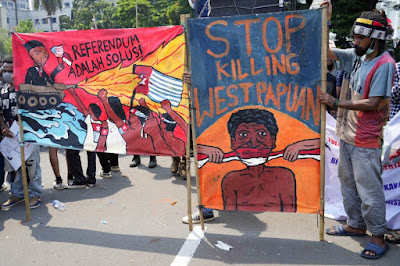


Papuan activists display banners during a rally commemorating the 61st anniversary 

of the failed efforts by Papuan tribal chiefs to declare independence from Dutch colonial 

rule in 1961, in Jakarta, Indonesia,Thursday, Dec. 1, 2022.

 Credit: AP Photo/Tatan Syuflana


Indonesia’s newly appointed military chief has played down the seriousness of the situation in Papua, after several years of worsening conflict in the restive eastern region. According to a report by BenarNews, Adm. Yudo Margono, who was sworn into his position on Monday, was responding to a question from a reporter about whether the increase in violent attacks over the past few years had reached the level of an emergency.

“Not yet. I don’t think it has reached that level,” he said. “So far it remains a criminal law enforcement issue, so Indonesian police are in charge, but we are helping law enforcement.”

The questioner referenced an incident on Monday in which police fired on villagers who had attacked a police station in Tolikara regency, in the newly formed Papua Highlands province, with “sharp weapons and arrows,” as CNN Indonesia reported. In the incident, one resident was reportedly shot dead and another eight were injured.

The incident reflected the growing level of violence in the two provinces of Indonesian Papua, which is home to a long-running separatist insurgency.


Yudo’s comments came a day after President Joko “Jokowi” Widodo announced that he supports plans to reduce the troop presence in Papua – though not a softening of the government’s policy there. According to Reuters, the Indonesian leader said that “the reduction of military troops in Papua is good, but we need to continue to be stern.” Otherwise, he said, armed rebel groups will always continue to operate there and “the problem will never end.”

While the Papuan independence movement dates back to Indonesia’s annexation of the former Dutch colony in 1963, the situation has worsened considerably since 2018, when guerilla fighters of the West Papua National Liberation Army killed 16 laborers working on the Trans-Papua Highway. Jakarta responded to the attack by deploying thousands of troops to the region. The ensuing conflict has resulted in deaths on both sides, dozens of arrests, and the mass displacement of Papuan villagers caught in the middle of the conflict.

According to a recent report from the Jakarta-based Institute for Policy Analysis of Conflict, the frequency of violent insurgency-related attacks has increased from an average of 11 incidents per year between 2010 to 2017 to 52 incidents per year during 2018-2021. In November 2020, the United Nations said that there had been “repeated reports of extra-judicial killings, excessive use of force, arrest and continuous harassment and intimidation of protesters and human rights defenders” since 2018.

The situation has worsened further since April 2021, after Papuan separatist rebels ambushed and assassinated Brig. Gen. Gusti Putu Danny Nugraha, the head of Indonesia’s intelligence agency in the eastern province. The assassination led the government to formally designate Papuan separatists as “terrorists” and deployed further troops to remote parts of Papua and West Papua provinces.


It is tempting to view Jokowi’s comments about a possible reduction in the Indonesian troop presence in Papua and West Papua as a step toward a more humane and effective policy – and an admission that the hard line toward the region has failed. But the Indonesian leader’s continuing call for a “stern” policy almost guarantees that no matter the exact number of deployed troops, his administration will continue to lean into the spiral of conflict that has engulfed the region since 2018.

———————————————

http://www.indoleft.org/news/2022-12-19/nationalist-thugs-break-up-papua-rally-marking-61-years-since-trikora-operation.html


3) Nationalist thugs break up Papua rally marking 61 years since Trikora operation

CNN Indonesia – December 19, 2022

Jakarta – An action in front of the United Nations representative office in Jakarta by Papuan activists commemorating 61 years since the Triple Commands of the People (Trikora) military operation was forcibly broken up by members of a group calling themselves the "Defend the Unitary State of the Republic of Indonesia" (Bela NKRI).

Based on CNN Indonesia's observations at the location, as soon as the Bela NKRI members arrived, they broke through the police lines and headed in the direction of the Papuan protesters. They then began pushing and shoving the demonstrators trying to forcibly remove them from the location.

The Papuan protesters tried to hold their ground asking the group not to keep pushing them. They also protested the intimidation saying that the Papua action was peaceful. Eventually they were force to leave the location.

The action was held to commemorate the 1961 Trikora operation which they said was inappropriate because if forced Papua to integrate into the NKRI.

"We're holding a peaceful action. Our friends see the Trikora operation as being inappropriate", said one of the representatives at the action, Surya Anta, on Monday December 19.

The former political prisoner also questioned the presence of the Bela NKRI group saying that the Papuan protesters had already submitted a written notification of the action in front of the UN offices with the police.

"The police need to be asked if they [the Bela NKRI group] have [also] followed police regulations by providing a letter of notification [to police] or not because we provided a notification", said Surya.

In the end, at 3.30 pm the Papuan protesters withdrew and disbanded because of the continued pressure from the Bela NKRI.

According to a statement by Central Jakarta Metro District Police Chief Senior Commissioner Komarudin, there were indeed two groups that held a demonstration in front of the UN office in Jakarta today.

According to Komarudin, the two groups held the action without first providing a written notification.

He said that the chaos broke out when the Bela NKRI group was giving a speech and members of the Greater Jakarta Papua Student Front suddenly arrived at the location.

"They were shocked (the Bela NKRI), so when they (the Papuans) arrived, they tried to remove them", said Komarudin when contacted.

According to Komarudin, the chaos broke out at around 3.30 pm. He claimed however that there was no scuffle between the groups or items thrown during the incident.

"No (there was no pushing or shoving or throwing things), there were officials on the ground, we blocked them, we separated them", he said.

Komarudin said that the chaos only lasted around 10 minutes adding that by around 4 pm the situation was under control again. (yla/dis/tsa)

Notes

Operation Trikora was declared by Indonesian founding President Sukarno in the Central Java city of Yogyakarta on December 19, 1961. It was an Indonesian military operation aimed at harassing and forcing the Dutch out of Netherlands New Guinea in 1961-62 rather than one intended to suppress a nascent independence movement. Under the threat that Indonesia would move from armed infiltrations to a large-scale military attack, US sponsored negotiations led to the signing of the New York Agreement on August 15, 1962 in which the Netherlands agreed to hand over administration of Western New Guinea to Indonesia pending a UN administered plebiscite. Seven years later under the newly installed Suharto dictatorship, the treaty led to the so-call "Act of Free Choice" in 1969 in which 1025 hand-picked Papuans "voted" at gun-point for the territory remain part of Indonesia.

[Translated by James Balowski. The original title of the article was "Massa Aksi Trikora Papua Bubar, Sempat Didorong-Dilempar Kertas".]

Source: https://www.cnnindonesia.com/nasional/20221219183750-12-889421/massa-aksi-trikora-papua-bubar-sempat-didorong-dilempar-kertas

--------------------------------


Tuesday, December 20, 2022

1) West Papuan campaigners want a ‘green state’. Could it help the planet?


2) Repression Can’t Snuff Out West Papua’s Struggle for Freedom

3) List of 10 regencies in Papua with highest deforestation rate 
4) LBH Talenta Keadilan Papua reports wrongful arrest and beatings   


---------------------------------


1) West Papuan campaigners want a ‘green state’. Could it help the planet?

OPINION: Independence activists want to combine the best parts of liberal democracy with indigenous traditions
 Ben Wray 20 December 2022, 11.20am


Due to the strength of their diverse indigenous traditions and the unique biodiversity of their lands, it is axiomatic for West Papuans that human life and nature are inseparable.

Now, the leaders of the province’s independence movement have a proposal to make it “Earth’s first green state”.

As Benny Wenda, exiled leader of the United Liberation Movement for West Papua (ULMWP), told a conference at Queen Mary University of London (QMUL) on 9 December: “The forest is our friend, our supermarket, our medical cabin. You cannot separate West Papua from our environment. We have always been at peace with nature.”

Unfortunately, the Indonesian government, which has maintained a bloody and brutal occupation of West Papua for almost 60 years, and the global corporations they invite to “develop” its lands, does not abide by such values.

West Papua, which is home to more than 250 tribes with their own languages and cultures, has the third largest rainforest in the world. But it is imperilled by gold mines, logging companies, palm oil plantations and many more forms of resource extraction that strip the land bare. Mine sedimentation kills off plants and natural life for hundreds of kilometres around.

According to Lisa Tilley, a political ecologist at SOAS University of London, these ecological “dead zones” are a “paradise for pathogens”.

“Genetic diversity is usually the firewall which prevents pathogens spreading and making those zoonotic [animal-to-human] shifts,” Tilley says.

The Indonesian government claims to want to be part of an “Opec for the rainforests” – along with the Democratic Republic of Congo and Brazil – a rival to the club of oil-producing nations, promoting conservation rather than fossil fuels. But the reality on the ground is that rainforest destruction is ramping up.

A gold mine the size of Jakarta, the Indonesian capital, is being planned. In the ongoing construction of the Trans-Papua Highway, a forest area the size of Denmark could be cleared by 2036. The BBC reported in 2020 that Korean palm oil giant Korindo has cleared nearly 60,000 hectares of West Papuan forest, an area the size of Seoul.

An eco-revolution in West Papua, to protect this valuable landscape, is in all of our interests.


We have the solution to the global climate crisis. Indigenous people should be able to manage their lands as they have done for thousands of years
Benny Wenda, United Liberation Movement for West Papua


Wenda and the ULMWP have a plan for such a transformation. The Green State Vision is part of their programme for independence.

“The Green State Vision is our offer to the world,” Wenda said. “We have the solution to the global climate crisis. Indigenous people should be able to manage their lands as they have done for thousands of years.”

The Green State Vision was developed based on the values of the indigenous Melanesian tribes of West Papua, where living in balance and harmony with nature are core values, and collectivity is emphasised over individualism. There are “three pillars” to the vision: environmental and social protection; customary guardianship; and democratic governance.

Measures would include making ecocide a serious criminal offence and compelling resource extraction companies to work within an ecologically sustainable framework. Guardianship of the forests, lands and rivers will be restored to “customary authorities at family, clan and tribal level”.

The political model is an attempt to combine “the best features” of a liberal democratic state – a legislature, an independent judiciary, and so on – with approaches rooted in holistic indigenous practices that prioritise community-based decision making and collective land rights. Could other parts of the world benefit from a similar approach?

Lessons for the rest of the world

As Joan Martinez-Alier, author of ‘Environmentalism for the Poor’, pointed out at the conference, while 5% of the world population is officially considered to be indigenous, they appear in 40% of known environmental justice disputes in the world.

The fact that indigenous communities tend to live off lands that hitherto have not been the object of ‘development’, and thus tend to be resource-rich, makes them targets for extractivist modes of capital accumulation. As such, environmental violence and resistance usually follows.

“Indigenous people are defending their rights at the extraction frontiers, motivated by their own cultural values and interests – sacredness, identity and livelihood – against coloniality and racism,” Martinez-Alier added.

But even in the non-indigenous world, where workers have long since been torn from the land and survive via the market, inspiration can be taken from the Green State Vision’s willingness to criminalise ecocide and challenge the apparently sacred ‘right’ of capital to ruthlessly exploit nature.

David Whyte, director of the Centre for Climate Crime and Climate Justice at QMUL, said struggles for environmental justice in West Papua and countries like the UK are more intimately connected than we might think.

“If we don’t protect the world’s major forests from predatory business investors, then we have no chance at all to prevent global warming,” he explained. “Without the Amazon, the Congo and the New Guinea forests, the world stops breathing. London-based companies are major beneficiaries of this. The likes of BP and Unilever, heavily invested in West Papua, quite literally profit from our asphyxiation.  

“The West Papuan Green State Vision offers us a way out of the predatory cycle. It offers the most viable way for us to keep us all breathing and to keep us all alive.”

-------------------------------------


2) Repression Can’t Snuff Out West Papua’s Struggle for Freedom
AN INTERVIEW WITH BENNY WENDA
Since Indonesia annexed West Papua, its people have faced brutal military repression while the US helps whitewash the occupation. But the country’s freedom movement is pressing ahead with a unique liberation project based on ecological principles.

West Papua has the world’s third-largest rainforest and is one of its most biodiverse areas, with an equally rich array of indigenous tribes and languages. It is also the site of a long but little-known struggle for self-determination. In the 1960s, West Papua exchanged one colonial occupier, the Netherlands, for another, Indonesia. Its people have been struggling against Indonesian rule ever since.

Amnesty International estimates that the Indonesian military has killed at least one hundred thousand West Papuans in that time; other estimates are even higher. West Papuans have suffered systematic racial discrimination and land theft. The global mining, palm oil, and logging corporations operating in their lands are wiping out irreplaceable natural habits. But a media blackout has kept the experience of West Papua largely concealed from the outside world.

As a child, Benny Wenda lived in a remote village among the Lani people who rebelled against Indonesian control in the 1970s, and he witnessed the brutal repression that followed, including sexual violence against his female relatives. While at university, Wenda began to learn about the suppressed history of his country and its culture and organized West Papua study groups. He became a leader of the West Papuan independence movement.

After being arrested on trumped-up charges in 2002, Wenda was tortured and held in solitary confinement. Facing a twenty-five-year prison sentence, he soon escaped and eventually received political asylum in the UK. Wenda is the leader of the United Liberation Movement for West Papua (ULMWP), established in 2014 to bring together the three main political organizations campaigning for West Papuan independence.

In 2017, the ULMWP presented a petition to the UN with 1.8 million West Papuan signatures — 70 percent of the population — calling for self-determination. In 2020, the movement announced it was establishing a provisional government for West Papua, with Wenda as the interim president.

Last year, the ULMWP launched its “Green State Vision” at the COP26 summit in Glasgow. It aspires for West Papua “to be the world’s first Green state” by making ecocide a criminal offence and “serving notice” on all extraction companies operating in West Papua.


BEN WRAY

Why did Dutch colonial rule not end for West Papua at the same time that it ended for Indonesia in 1949? How did West Papua come to be under Indonesian occupation by 1963?

BENNY WENDA

Indonesia and West Papua were both Dutch colonies. After Indonesia became independent, the Dutch argued that West Papua was separate, that its people were different from those of Indonesia — culturally, linguistically, geographically. The Dutch held on to West Papua for over a decade after Indonesian independence. Then, in 1960, they prepared to give us independence. They formed the Dutch–New Guinea Council, and the West Papua flag was recognized.

Indonesia said: “No, the rest of the Dutch colony, including West Papua, is ours.” But the Dutch kept saying that West Papua was separate. Then Indonesia’s leaders used another strategy. This was the time of the Cold War, and they saw this as a chance to convince the Americans, the British, and other European countries.

They said: “If you don’t give West Papua to us, we will join the other side in the Cold War,” because communists had emerged as a major political force in Indonesia, so the big Western powers saw this as a threat. Indonesia successfully played this Cold War game to get Washington’s backing for its claim over West Papua.

On August 15, 1962, in what is known as the New York Agreement, there was a secret deal between the United States, Indonesia, and the UN. Without any West Papuans being involved, they decided our future


The deal was to transfer sovereignty to Indonesia and then hold a referendum on West Papua’s future status by 1969, which was to be on the basis of one person, one vote.

However, what actually happened in 1969 was that Indonesia handpicked 1,022 people, put them in a room, and forced them to vote. Indonesia called it the “Act of Free Choice,” but we call it the “Act of No Choice.” Even a representative from the UN said that it was a whitewash. The UN never recognized the result, and it still doesn’t today: in fact, the UN has said that it regrets being involved in the process.

That’s why the legal argument to reclaim our territory is very strong. We were basically crucified for the sake of the interests of the global powers.


BEN  WRAY In the 1970s and after, there was fierce West Papuan resistance to Indonesian control. Can you talk us through those years of resistance and Indonesian repression under Suharto’s dictatorship?

BENNY WENDA

It was like a nightmare. You couldn’t say the words “West Papua” or even “Papua” — you just had to say “Irian Jaya,” the term favored by the Indonesian authorities. In the Suharto era, we were totally isolated from the rest of the world. The media was totally banned from West Papua.


"In the Suharto era, we were totally isolated from the rest of the world. The media was totally banned from West Papua.”


The legacy of the Suharto era still carries on to the present. Under Suharto, it was terrible, but honestly it is still terrible today, because Indonesia sees us as its colony and treats us that way.

BEN WRAY

Suharto’s dictatorship ended in 1998, and East Timor won independence from Indonesian rule in 1999. What prevented West Papua from following East Timor’s example?

BENNY WENDA

When Suharto resigned, East Timor became independent, and we too, in 2000, fought for our independence. It was called the Papuan Spring. Our flag, the Morning Star, was raised almost everywhere, and we appointed a leader called Theys Eluay: we had a congress to vote for him, and he was like our president in a way.


But Theys Eluay was killed in 2001. The Indonesian authorities arrested me in 2002, because I was the leader of the tribal assembly at the time. They wanted to kill me, so I escaped.

Every leader that emerged in West Papua was always killed. The Indonesian government offered us what it called “special autonomy” in 2001, and we were forced to accept it at gunpoint. But West Papuans still want independence.

BEN WRAY

What is the reality on the ground today? Has the regime changed at all since you were imprisoned and tortured in 2002?

BENNY WENDA

Between sixty thousand and a hundred thousand people have been displaced from their homes. Since the occupation began, almost 450,000 West Papuans have been killed in total, mainly women and children. Just the other day, three West Papuan students were arrested just for holding the Morning Star flag. Many West Papuans are held in Indonesian prisons. I think the situation has gotten worse and worse.

BEN WRAY

The Indonesian government of Joko Widodo, in office since 2014, recently made headlines after introducing a law that banned sex outside marriage. Has the occupation of West Papua changed under Widodo’s rule?

BENNY WENDA

For us, every new Indonesian president brings no change. It’s the same with Widodo. He has visited West Papua fifteen or twenty times, but nothing has changed. In fact, he has sent twenty-five thousand troops to the West Papua militarized zone.


"The Indonesian government knows that West Papua is illegally occupied, but it won’t let go because Indonesia is economically dependent on West Papuan resources.”


The Indonesian government knows that West Papua is illegally occupied, but it won’t let go because Indonesia is economically dependent on West Papuan resources. That’s a key reason it holds West Papua by military force.

BEN WRAY

The United States has maintained close relations with Indonesia since 1949, seemingly regardless of who was in power in Jakarta. Is US imperialism a block on West Papua’s struggle for independence?

BENNY WENDA

Yes, because the United States wanted to keep Indonesia on its side, because it was worried about the Cold War. Today, the emergence of China as a US competitor influences Washington’s policy toward Indonesia and West Papua. The United States also wants to be on good terms with the Indonesian government to extract resources, because it benefits the American economy.


In addition, no one really knows about what is happening in West Papua. However, as people find out about it, the big powers will change their view. If you look at the Vietnam War or the South African struggle against apartheid, when ordinary people put pressure on their governments, they can change this situation.

BEN WRAY In the last few years, we have seen an increase in resistance to Indonesian rule within West Papua.

BENNY WENDA

The West Papuan people, inside and outside West Papua, have been very strong in the last five years. They have been protesting and resisting peacefully. But the Indonesian authorities have responded with a crackdown through military force. When people are protesting on the streets, they use tear gas or kill them.


However, nobody reports on what is happening because of the media ban, so it’s very difficult to bring it to the world’s attention. Everyday there are protests on the streets. Religious pastors are being killed and churches are being burned down. The Indonesian military even shoots children, but because of the media ban, it can act with impunity. That is the biggest problem we are facing.

BEN WRAY

West Papua’s rainforest makes it very important for the whole world in preventing climate breakdown. At the recent COP27 summit, the governments of Indonesia, the Democratic Republic of Congo, and Brazil announced that they want to establish an “OPEC for rainforests”. What did you think of that announcement?

BENNY WENDA

It’s a cover-up. Indonesia is directly destroying the rainforests. The idea of “OPEC for rainforests” is good PR for the country to be a global player. Even if it signs global agreements, for us, it’s just a question of pretending to be doing something, because we know what is really happening to the environment in West Papua. I think this is an attempt at propaganda to counter our Green State Vision for West Papua.

BEN WRAY

What sort of economy and society are you aspiring to create in West Papua with the Green State Vision?

BENNY WENDA

What we want is a democratic society, just like any other country. But we believe in a form of democratic governance in the context of our beliefs, our customs, and our norms. This is a balance between Western-style democracy and our own beliefs and traditions. Key to this is a belief in peace and harmony with nature.

"Nature — our rivers, our forests, our mountains — is connected to us, and we want to respect it.”


For us, everything is based on what we need. For example, if you want to build a house and a garden, everyone comes together to discuss “who does this land belong to?” etc. We discuss on the basis of our values and then we agree to build a garden to share. This already existed before Western-style democracy came to our world.

Nature — our rivers, our forests, our mountains — is connected to us, and we want to respect it. The people and businesses that come to our world need to respect our customs and laws. Before a company invests, they need to follow our Vision. We are not against them investing, but they need to respect our laws and the meaning of the Green State Vision.

BEN WRAY

Six decades of Indonesian occupation have obviously changed West Papua. Almost half of the population of West Papua is now Indonesian. Are you concerned that over time, these changes will undermine the basis for a West Papuan state?

BENNY WENDA

Absolutely, this is a threat. The Indonesian government has used resettlement programs to bring Indonesians to West Papua and grab the land. They want West Papuans to eventually become a minority that will be easy to control. That is why we are fighting hard now, through the protests, the campaigns, and the lobbying, and by winning the support of ordinary Indonesians, listening to us and supporting our struggle.


CONTRIBUTORS

Benny Wenda is the leader of the United Liberation Movement of West Papua.

Ben Wray is the author, with Neil Davidson and James Foley, of Scotland After Britain: The Two Souls of Scottish Independence (Verso Books, 2022).


————————————————————

3) List of 10 regencies in Papua with highest deforestation rate   
News Desk - Papua Deforestation 
20 December 2022


Jayapura, Jubi – Head of Greenpeace Indonesia’s Forest Campaign Kiki Taufik said there are ten regencies in Papua island with the highest deforestation rate from 2001 to 2020. Deforestation occurs due to overissuance of licenses for land-based extractive industries that threaten the rights of indigenous Papuans.

This was conveyed by Taufik in an online discussion of the research report “The Curse of Natural Resources in the Land of Papua” organized by Greenpeace in collaboration with the Institute for Development of Economics and Finance (IDEF) on Monday, December 19, 2022. Kiki said that in the last two decades, Papua has been the region with the highest deforestation rate in Indonesia.

Greenpeace and IDEF’s research shows that at least 417,800 ha of natural forest have been lost in ten Papua regencies. Of the ten regencies, half of them are in Papua Province, with the loss of natural forest reaching 292,100 ha. The five regencies are Merauke Regency (92,200 ha), Boven Digoel Regency (69,800 ha), Mappi Regency (30,200 ha), Nabire Regency (36,000 ha), Keerom Regency (29,900 ha) and Mimika Regency (34,000 ha).

Deforestation at a high rate also occurred in West Papua Province, with the area of natural forest lost reaching 125,700 ha. The five regencies are Fakfak Regency (36,100 ha), Teluk Bintuni Regency (31,700 ha), Manokwari Regency (28,700 ha) and Sorong Regency (29,200 ha).

Land-based extractive industries such as mining, Industrial Plantation Forest (HTI), Forest Concession Rights (HPH), and oil palm plantations are rampant in Papua, leading to deforestation. The formation of New Autonomous Regions (DOB) such as the three new provinces can also accelerate deforestation.

Rosita Tecuari, the chairperson of the Namblong Tribal Women’s Organization in Jayapura Regency, said that permit-based exploitation of natural resources has marginalized the rights of indigenous Papuans. “We have experienced firsthand how our forests were forcibly taken by the company, while we who own the customary land do not get any welfare,” she said.

Tecuari said that she and the indigenous people in the Grime Nawa valley are currently fighting to reject palm oil company PT Permata Nusa Mandiri. According to Tecuari, the company has cleared up to a hundred hectares of land belonging to the indigenous community without permission.


Tecuari said that the presence of the company did not have a positive impact on the indigenous community. Instead, the company’s activities are destroying nature and the land that is the source of life for the indigenous people.

“The forest for us is a place to find food. We take vegetables and side dishes from the forest, not in the city or in shops,” she said. (*)


——————————————————

4) LBH Talenta Keadilan Papua reports wrongful arrest and beatings   
News Desk - Alleged Wrongful Arrest 
20 December 2022

Nabire, Jubi – The Talenta Keadilan Papua Legal Aid Institute (LBH-TK) reported the wrongful arrest of two students named  ET and DT, who were accused of carrying firearms. LBH-TK reported the case to the Nabire Police in Central Papua Province on Monday, December 19, 2022.

Director of LBH-TK Richardani Nawipa said ET and DT were arrested on Saturday, December 17, and were also beaten by police when they were arrested at Samabusa Harbor.

“The police investigated two students, ET and DT, who allegedly brought firearms from Jayapura to Nabire. It turned out to be a toy gun. ET and DT were sent home on Sunday,” Nawipa told Jubi on Monday.

ET is a Cenderawasih University student from Paniai Regency, while DT is a student of Satya Wiyata Mandala University Nabire who lives in Sanoba Atas, Nabire Regency.

ET and DT were arrested when they were about to disembark from the Gunung Dempo Ship, which sailed from Jayapura City and docked at Samabusa Port on Saturday. A number of security forces boarded the ship and arrested the two students accused of carrying firearms. Both were taken to the Nabire Police Headquarters.

Nawipa said the beatings against ET and DT occurred in the car during their trip to Nabire Police Headquarters, as well as at the headquarters. Later, the police realized that the firearms were toys.

“It was a wrongful arrest as they did not carry firearms. We reported the beating to the internal division at the police,” he said.


Nawipa said the actions of the perpetrators were an offense of persecution as stipulated in Article 351 of the Criminal Code and police disciplinary regulations. “We are assisting the victims and we condemn the unprofessional actions taken by security forces. We ask that the perpetrators be held responsible,” said Nawipa. (*)

-------------------------