Friday, July 4, 2025

1) Security-backed intimidation of indigenous community in Sayosa Timur linked to timber exploitation


2) Environmental destruction and indigenous rights violations: The Nickel mining crisis in Raja Ampat

3) In bed with a (pig’s) head- packages of dead animals intimidate media and activists 

4) Papua govt calls for prioritizing locals in healthcare recruitment 

5) Papua can drive national development forward: Minister  
6) Ministry targets 24 type C hospitals in Papua  


-------------------------

Human Rights Monitor

https://humanrightsmonitor.org/case/security-backed-intimidation-of-indigenous-community-in-sayosa-timur-sorong-linked-to-timber-exploitation/

1) Security-backed intimidation of indigenous community in Sayosa Timur linked to timber exploitation

According to local accounts, including statements by community leaders, Brimob personnel have carried out arbitrary checks. Some elders were allegedly given state-issued weapons for staged photographs, raising concerns about potential criminalisation or manipulation. Traditional hunting and gathering activities have been severely disrupted due to the heavy presence of armed personnel. The situation escalated when the community re-erected traditional barricades after the initial structure was destroyed. Despite a meeting held on 28 June 2025 between the community, Sorong Regency government, local legislative bodies (DPRD and MRP PBD), and police, residents remain dissatisfied with the unilateral actions of Brimob personnel and the lack of accountability.
The community demands the withdrawal of Brimob from company premises, a review of the operating licences of PT MAM and PT SKS, and legal consequences for officers involved in acts of intimidation. Their demands include the immediate asphalting of local roads to facilitate community mobility and a transparent, inclusive process for resolving conflicts over land and economic rights.
The case reflects broader patterns of militarised resource extraction in West Papua, where state security forces are deployed to serve corporate interests rather than public safety, in clear violation of both Indonesia’s constitutional protections and international human rights law. The intersection of extractive industry interests and militarised state presence in indigenous territories accelerates the marginalisation of indigenous communities in West Papua. The loss of access to their land makes indigenous communities particularly vulnerable to impoverishment.

Road block erected by community in the Sayosa Timur District, Sorong Regency, Papua Barat Daya Province


------------------------------------

Human Rights Monitor

https://humanrightsmonitor.org/news/environmental-destruction-and-indigenous-rights-violations-the-nickel-mining-crisis-in-raja-ampat/

2) Environmental destruction and indigenous rights violations: The Nickel mining crisis in Raja Ampat

The pristine waters and biodiversity-rich islands of Raja Ampat, Papua Barat Daya Province, are facing a devastating environmental and human rights crisis as multiple nickel mining companies destroy one of the world’s most ecologically significant marine areas in the world. Despite Raja Ampat’s recognition as a UNESCO Global Geopark in 2023 and its status as the heart of the global coral triangle, containing 75% of the world’s coral species, the Indonesian government has permitted extensive mining operations across several small islands. The mining operations are violating both national law and international conservation standards.
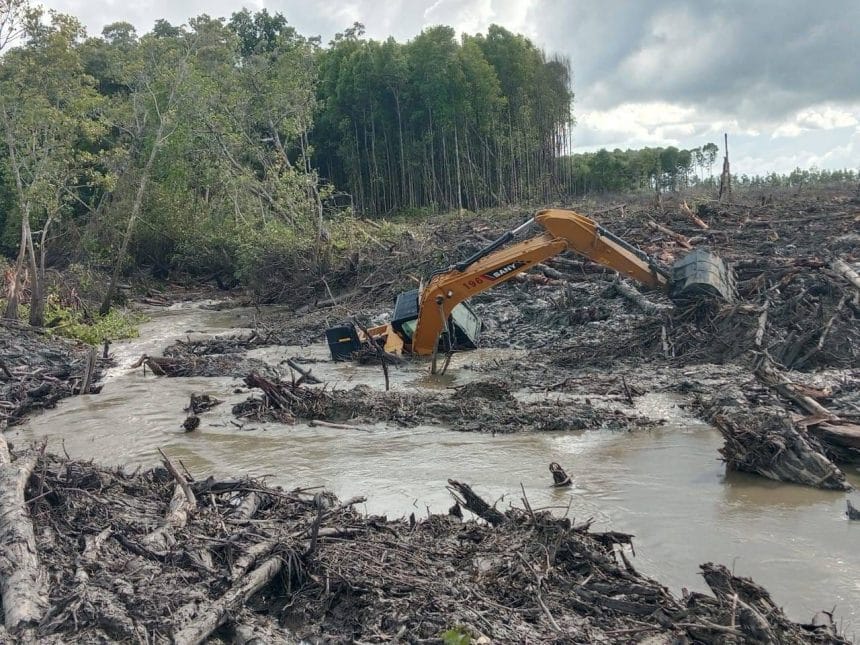
Between 8-27 June 2025, widespread protests erupted across Indonesia as indigenous communities, environmental activists, and civil society organizations demanded an end to the destructive mining practices that have already cleared over 500 hectares of forest and natural vegetation. The environmental damage extends far beyond deforestation, with mining waste causing severe sedimentation that affects the coral reefs, contaminated coastal waters, and destroys the marine ecosystems that indigenous communities in Raja Ampat depend upon. On Manuran Island, mining operations by PT Anugerah Surya Pratama have created visible pollution plumes that flow directly into village areas during high tide, while residents on Gag Island report being afraid to swim due to fears of skin diseases caused by contaminated waters.
The human rights implications of these mining operations are profound and systematic. Indigenous communities have been denied their fundamental right to free, prior, and informed consent (FPIC) regarding mining activities on their ancestral lands. The operations have divided communities, with mining companies reportedly offering financial incentives to secure local support while those who resist face intimidation and marginalization. Traditional livelihoods dependent on fishing and sustainable tourism are under threat, forcing communities into economic vulnerability and dependence on unstable mining employment. The government’s failure to consult with affected communities before issuing permits violates international indigenous rights standards and Indonesia’s constitutional protections for customary communities.
The legal framework governing these operations reveals the extent of governmental complicity in the violations. All mining activities on small islands in Raja Ampat directly contravene Article 35(k) of Law No. 1 of 2014 on Coastal Area and Small Islands Management, which explicitly prohibits mineral mining that causes environmental damage or harm to surrounding communities. Despite this legal prohibition, at least five companies, namely PT Gag Nikel, PT Anugerah Surya Pratama, PT Mulia Raymond Perkasa, PT Kawei Sejahtera Mining, and PT Nurham, have been granted mining permits covering thousands of hectares across the archipelago. When Minister of Energy and Mineral Resources Bahlil Lahadalia visited the region in June 2025, he was met with massive protests at Sorong Airport, forcing him to exit through a back door to avoid demonstrators demanding the immediate revocation of all mining permits.
Civil society responses have highlighted the broader pattern of environmental injustice and corporate impunity. The Papua Coalition for Law Enforcement and Human Rights has accused government officials of maladministration for interfering with proper environmental monitoring procedures, while indigenous groups have organized coordinated protests across multiple cities demanding not only the cessation of mining in Raja Ampat but the end of all extractive projects throughout West Papua. Some activists like Paulina, a 24-year-old woman from the  Kabare Village, have faced arrest for peaceful protests, yet continue protesting.
Following sustained public pressure and international scrutiny, the Indonesian government announced on 10 June 2025, the revocation of mining permits for four companies operating in Raja Ampat: PT Anugerah Surya Pratama, PT Kawei Sejahtera Mining, PT Mulia Raymond Perkasa, and PT Nurham. However, this decision has been met with skepticism from environmental groups and indigenous rights advocates who view it as inadequate and potentially reversible. Significantly, PT Gag Nikel, the largest operation owned by state-owned PT Antam, was permitted to continue operations under increased monitoring, raising concerns about the government’s commitment to genuine environmental protection versus protecting state corporate interests. Greenpeace Indonesia criticized the decision as merely “a ploy to quell protests,” noting that the fundamental legal violations remain unaddressed and that operations could potentially resume once public attention diminishes.
The destruction of Raja Ampat represents not merely an environmental catastrophe but a systematic violation of indigenous rights and environmental justice. The crisis in Raja Ampat serves as a critical test case for whether Indonesia will uphold its commitments to indigenous rights and environmental conservation or continue to sacrifice irreplaceable ecosystems and indigenous communities for corporate interests. Only the complete revocation of all mining permits and the recognition of indigenous land rights can prevent further destruction of this globally significant marine ecosystem.

Mining operations in Raja Ampat

Indigenous communities in various locations carried out protests against the Nickel mines in Raja Ampat throughout June’25


Map of Raja Ampat Geopark


-------------------------------

3) In bed with a (pig’s) head- packages of dead animals intimidate media and activists 

TAPOL 04 July 2025


Summary
  • Seven incidents of dead animals being sent to people between 19th March and 19th June.
  • Journalists, students and environmental activists targeted in a new wave of intimidation.
  • Intimidation started as TNI law was being passed and continued with targeting of activists in Sumatra and Papuan students and activists across Indonesia

In the last few months, a disturbing trend has become apparent in a string of incidents across Indonesia: the sending of innocuous packages that contain the corpses of dead animals. Whilst the actors, cases and context of each incident may differ, the very fact this newly prominent technique was used to intimidate them displays a commonality in tactics that hides the perpetrator and is designed to cause an atmosphere of fear. The parallels of the recipients of these packages shows a trend of targeted intimidation designed to cause fear and silence those speaking out against embedded interests.

Tempo Media were the first to be hit by this new wave of dead animal packages. On 19th March, a package containing a rotting pig’s head addressed to Francisca (‘Cica’) Christy Rosana, a Tempo journalist and one of the hosts of the popular podcast Bocor AlusPolitik, which critically covers some of the biggest stories in Indonesian politics, was sent to Tempo’s office. An Instagram account, @derrynoah, threatened that the pig’s head would be followed up by burning down Tempo’s offices, as well as a targeting of her family. A package containing six headless mice was also sent to the office on 22nd March. As this sequence of events occurred in the run-up to the passing of the controversial TNI (Military) Law, which she and the podcast had been critically covering, it seemed likely to be an attempt to intimidate and silence criticism of the new law, and allow it to pass without opposition.

A second incident affected Delima Silalahi, an environmental activist based in North Sumatra, who received a package containing a bloody carcass of a bird addressed to her at her house on 30th May. Delima and others had demanded the closure of PT Toba Pulp Lestari, a company that had been accused of causing an ecological and social crisis in the community through its deforestation activities. The timing and target of the package coincides again with the fact that someone was speaking up on an issue against vested interests.

Furthermore, Papuan students across Indonesia received packages across Indonesia on three separate occasions in June. On 6th June in Denpasar, Bali, two packages were received by students, containing rotting pig’s heads. One of the packages, addressed to Wemison Enembe, had a note saying it contained the book Papua Bergerak (Papua on the Move), which turned out to be false. The book itself had already been part of an intimidation campaign, when its launch on 18th May was disrupted by people who had received a hoax invitation claiming that they were handing out money and groceries at the event. Wemison himself is the chair of the Bali chapter of the Papuan Student Alliance (Aliansi Mahasiswa Papua, AMP). The alliance, both in Bali and nationally, has organised a number of protests in the past several years. The second package was delivered later in the evening to another residence full of Papuan students, this time addressed to Yuberthinus Gobay, a member of the national executive of the same organisation. The timing and recipients of these packages bear the hallmarks of attempts to intimidate Papuan students activists and their supporters from carrying out further protests.


Incident Map 19th March to 19th June. Background map Source: OpenStreetMap

This was followed up on 18-19th June with another package, this time with threatening notes and a dead chicken and chicken droppings, to other members of AMP in Yogyakarta. Thirdly, also on 19th June, AMP members in Surabaya received a package containing a dead monitor lizard, after receiving threats from an unknown phone number and seeing threatening posters plastered around the city. This arose after their participation in protests against militarism in West Papua.  

This renewed surge is not entirely without precedent. Veronica Koman, a human rights defender and lawyer, had boxes sent to her and her family threatening retribution for her work, including a dead chicken with a message stating that anyone ‘hiding’ her “would end up like this”. Nevertheless, the increasing prevalence of this tactic has contributed to a climate of fear amongst the media and human rights defenders. This is very worrying and needs to be taken seriously by the Indonesian Government, as is their duty, as the suspicion of collusion hangs over these incidents where those receiving the packages have been critics of government policy or the actions of oligarchs. TAPOL calls upon the police force to condemn these acts in the strongest possible terms and to find the perpetrators and bring them to justice. 


Image: Alliance of Papuan Students

Themes

———————————————————

4) Papua govt calls for prioritizing locals in healthcare recruitment 
 July 4, 2025 22:25 GMT+700

Jayapura, Papua (ANTARA) - The Papua government has urged the Ministry of Health to devise affirmative policies that prioritize indigenous Papuans in filling medical personnel vacancies in the province.

Acting Regional Secretary of Papua Suzana Wanggai said here on Friday that many local Papuan youth now possess medical skills.

“We request special affirmative action for Papuan children in the recruitment of health workers, especially at central government hospitals such as those in Jayapura,” she said at the groundbreaking ceremony for Kwaingga Hospital in Keerom District, Papua.

Wanggai noted that indigenous Papuan youth have shown strong competence in the health field and should be given opportunities for recruitment through affirmative policies.

“We hope that staffing for this hospital, which is under the auspices of the Ministry of Health, will prioritize the local community,” she added.

She explained that recruiting health workers from Papua would help address the urgent issue of hospital staffing shortages and therefore, improve healthcare services for the community.

Related news: Ministry targets 24 type C hospitals in Papua

“Medical personnel from outside Papua often request transfers after a few years due to family reasons. This is not a matter of discrimination; it is about ensuring continuity of care. We need health workers who are willing to stay and serve in Papua,” she emphasized.

Meanwhile, Minister of Health Budi Gunadi Sadikin affirmed his commitment to supporting indigenous Papuan general practitioners who wish to pursue specialist training through scholarship programs.

He also urged the local government to collect data on local medical personnel so they can be prioritized in the government’s medical education programs.

“We are ready to help. If there is a doctor whose education is funded by the regional government but later requests a transfer, report it to me. We can hold their practice license,” he said. 

Related news: Restoring health, education services in Yahukimo: minister


Translator: Qadri, Kenzu
Editor: Rahmad Nasution


--------------------------------------------


5) Papua can drive national development forward: Minister  

July 4, 2025 16:18 GMT+700

Jakarta (ANTARA) - Minister of Higher Education, Science, and Technology Brian Yuliarto expressed confidence that the Papua region can play a central role in Indonesia's journey toward a better future.

"I am not here for a mere working visit, as I intend to demonstrate my genuine commitment and dedication (to this region). I am convinced that this spirit will live on," the minister noted in an official statement cited here on Friday.

Yuliarto made the statements during a public lecture at Cendrawasih University in Jayapura, Papua Province, on Thursday (July 3).

The minister emphasized that his visit serves as a testament to his respect and gratitude for the people of Papua for their unwavering spirit and hope for progress despite facing myriad challenges.

Speaking to over one thousand students, academicians, and local community figures, he highlighted the importance of the people of the easternmost region of Indonesia supporting the transformation of the higher education system, fostering self-reliance, and driving innovations.

Addressing students, Yuliarto stressed their vital role in transforming local universities into engines of progress and sources of solutions for social and economic challenges.

He underlined that campuses should not only generate high-quality human resources but also emerge as prolific research centers in support of the formulation and implementation of strategic policies.

The Ministry of Higher Education, Science, and Technology offers a variety of initiatives to boost access to universities for all citizens, including those in Papua, such as the Indonesia Smart College Card (KIP Kuliah).

Furthermore, the ministry has introduced the Higher Education Affirmation Scholarship for students with disabilities, as well as the Indonesian College Student Dormitory (AMN) Scholarship, which reserves a minimum quota of 40 percent for Papuan students.

In addition, the Directorate of Learning and Student Affairs is working to launch a guideline for the establishment of units dedicated to students with disabilities at universities.

Related news: Indonesia, Russia forge deeper relations in higher education

Related news: Govt prioritizes scholarships for lecturers in remote areas


Translator: Sean F, Tegar Nurfitra
Editor: Arie Novarina


———————————


6) Ministry targets 24 type C hospitals in Papua  
July 4, 2025 18:47 GMT+700


Papua (ANTARA) - The Health Ministry aims to establish 24 type C hospitals across Papua to provide high-quality healthcare for local residents.

"I received a directive from the president to establish type C hospitals in 514 districts and cities, and in Papua, it is targeted to build some 24 hospitals," Health Minister Budi Gunadi Sadikin stated at the groundbreaking ceremony for Kwaingga Hospital in Keerom, Papua, on Friday.

The minister explained that these hospitals are part of the Quick Win programs. Sadikin expects the 24 hospitals to be completed in two years.

Related news: Papua's Jayapura General Hospital to improve healthcare access

The minister stated that President Prabowo Subianto is keen to reduce lengthy referral processes. These measures are intended to ensure that diseases can be treated locally, without the need for patients to travel to provincial hospitals.

"As a result, fewer patients will need to be referred to provincial hospitals, or even sent outside Papua for treatment," Sadikin noted.

He expected the regional government to also support the initiative by preparing medical and health personnel, so that healthcare services offered can be more optimal.

The minister stated that human resources will complement other aspects being improved, such as upgrading hospital equipment. 

Related news: Army providing free healthcare services to native Papuans in Kimaam

Translator: Qadri Pratiwi, Mecca Yumna Ning Prisie
Editor: Rahmad Nasution


------------------------------

Wednesday, July 2, 2025

1) Civil society condemns government denial and calls for international intervention

2) Arbitrary detention and use of force against human rights lawyer during peaceful protest in Jayapura

3) Trial begins in Tobias Silak Murder Case amid transparency concerns

4) Indonesian Govt Reports Poor Spending Performance in New Papua Province  

5) Govt ensures funding for Papua's new autonomous regions  


---------------------------------------
Human Rights Monitor

1) Civil society condemns government denial and calls for international intervention

In the past months, the situation surrounding the National Strategic Project (PSN) in Merauke, Papua Selatan Province, has further escalated. In the Soa Village, Tanah Miring District, indigenous women from 75 families have collectively opposed the land encroachment by PT. Global Papua Abadi, which received a government concession for an energy project without the community’s free, prior, and informed consent (FPIC). This project threatens to destroy their natural sources of livelihood and violates their rights to land and self-determination. Similarly, on 23 June 2025, indigenous land belonging to the Kwipalo clan in Kakyo Village, Semangga District, was reportedly seized by the military for the construction of a post without consent or legal process, constituting a grave act of militarisation and forced dispossession.
Investigations by the National Commission on Human Rights (Komnas HAM) in May and June 2025 revealed widespread violations across multiple districts in Merauke. These include forced evictions, destruction of sacred sites, and the complete disregard for FPIC principles. Indigenous communities, religious leaders, and civil society groups have united in protest, calling the PSN an instrument of structural injustice and ecocide. On 17 June 2025, the Indonesian Fellowship of Churches (PGI) condemned the PSN for violating indigenous rights, destroying ecosystems, and exacerbating the climate crisis.
In addition to public mobilisation and advocacy, a coalition of Indonesian civil society organisations (CSOs) issued a formal response to the joint communication of nine UN Special Rapporteurs dated 7 March 2025. The CSOs strongly criticised the Government of Indonesia’s reply of 6 May 2025 for denying ongoing and well-documented human rights and environmental violations related to the National Strategic Project (PSN) in Merauke. They noted that the government’s response ignored empirical evidence and failed to address the substantive issues raised by the UN experts, including land dispossession, militarisation, food insecurity, ecological destruction, and the lack of respect for FPIC principles
According to the CSOs, the government’s reply reflected a broader institutional reluctance to engage meaningfully with international human rights norms. They pointed out that the Indonesian state has failed to comply with recommendations made by Komnas HAM, as well as with constitutional and international legal standards safeguarding indigenous peoples’ rights. Furthermore, they underscored that permits and business licences had been granted to companies in areas with customary land claims, without community consent or proper consultation. The coalition urged the UN Special Rapporteurs to conduct direct monitoring in Merauke and called for the immediate suspension of PSN implementation to prevent the continued expansion of human rights and environmental violations.
The PSN’s implementation in Merauke reflects a deeper failure of democratic governance and environmental responsibility. It undermines constitutional protections and international legal obligations, particularly under the UN Declaration on the Rights of Indigenous Peoples. The Indonesian government’s response to concerns raised by UN Special Rapporteurs has been criticised as evasive and dishonest. Indigenous leaders and civil society continue to demand the immediate suspension of all PSN activities, restoration of customary lands, adequate reparations, and a UN-led investigation. Without urgent corrective action, the PSN will inevitably destroy the ecological, cultural, and spiritual fabric of West Papua’s indigenous communities.

The military seized land belonging to the Kwipalo Clan in the Kakyo Village, Semangga District, without consent or legal process


———————————————————————————
Human Rights Monitor


2) Arbitrary detention and use of force against human rights lawyer during peaceful protest in Jayapura

On 12 June 2025, police officers arbitrarily detained Mr Imanus Komba, a lawyer working for the Papuan Legal Aid Institute (LBH Papua), and a protester named Mr Kolki Gwijangge during a peaceful demonstration at the Abepura roundabout in Jayapura City, Papua Province (see photo on top, source: Jubi). The demonstration, organised by student and youth groups, opposed the controversial nickel mining project in Raja Ampat, Sorong, and broader illegal resource exploitation in West Papua. Mr Komba and Mr Gwijangge were reportedly subjected to physical ill-treatment during arrest. Both men were temporarily detained at the Abepura Sub-District Police Station before being released after 20 minutes.
The protest began peacefully at 10:00 am, with demonstrators expressing environmental and indigenous rights concerns over the mining project, including its impacts on local ecosystems and customary landowners. At approximately 10:20 am, police from the Abepura Sector, led by the station chief and intelligence officers, attempted to disband the protest, allegedly citing the lack of a valid permit. When LBH Papua lawyer, Mr Imanus Komba, challenged the order and asserted the demonstrators’ constitutional rights, police officers reportedly dragged, choked, and beat Mr Komba with a rubber baton before being escorted to the Abepura Sub-District Police Station. Mr Kolki Gwijangge was also forcibly removed from the site. Despite the violence, both were released again, and Mr Komba resumed his duties accompanying the protest.
The Indonesian Legal Aid Foundation (YLBHI) and LBH Papua condemned the detention, highlighting that such acts amount to a pattern of criminalisation and intimidation of human rights defenders in West Papua. According to YLBHI, the Abepura Police’s conduct represents a breach of Police Regulation No. 2/2003. The organisation demanded a public apology and an end to repressive policing.
The Jayapura Police Chief, Commissioner Fredrickus Maclarimboen, stated that there were no arrests or detentions. The Jayapura police’s claim that “there were no detainees” contrasts sharply with the victim testimonies, further underlining the lack of transparency and accountability.

Legal and human rights analysis

The actions of the Abepura police, including physical abuse and obstruction of legal assistance, amount to violations of national law and international standards on the protection of human rights defenders. The incident violates fundamental freedoms, namely the right to freedom of expression and peaceful assembly as enshrined in Article 28E (2) of the Indonesian Constitution, and Articles 19 and 21 of the International Covenant on Civil and Political Rights (ICCPR), to which Indonesia is a State Party. Furthermore, the physical assault and detention of the LBH lawyer violate Law No. 16/2011 on Legal Aid, which explicitly protects lawyers from criminal or civil liability for actions taken in the course of legal representation.
The case adds to a broader pattern of repression against Papuan civil society, where security forces frequently suppress dissent under the guise of public order, infringing upon basic civil liberties and undermining the rule of law.
———————————————————
Human Rights Monitor


3) Trial begins in Tobias Silak Murder Case amid transparency concerns

Nearly 11 months after the fatal shooting of Mr Tobias Silak in the Yahukimo Regency, Papua Pegunungan Province, criminal proceedings have commenced at the Wamena District Court against the four police officers, Muh. Kurniawan Kudu (Chief Police Brigadier, Bripka), Fernando Alexander Aufa, Ferdi Moses Koromath, and Jatmiko (see photo on top, source: WPCC). The case files were transferred to the Public Prosecutor in Wamena on 28 May 2025, with the first hearing held on 24 June 2025. The court session focused on the reading of indictments. However, the scheduled 30 June hearing for defendant objections was postponed due to the defence team’s lack of preparedness, raising early concerns about the pace of the proceedings.
The trial process has sparked significant transparency concerns, as the victim’s family and their legal counsel were not notified of the first hearing. Mr Kawer criticized the prosecutor’s failure to inform key stakeholders, questioning whether the prosecution truly represents victim interests or public interest as claimed. Additionally, legal representatives have expressed dissatisfaction with the charges brought against the defendants, primarily Article 338 (murder) and Article 395 (negligence causing death) of the Criminal Code KUHP. They argue that the more serious charge of premeditated murder under Article 340 would better reflect the gravity of the shooting that killed both Mr Tobias Silak and Mr Naro Dapla on 20 August 2024.
In response to these procedural concerns, the Indonesian Judicial Commission in Papua announced in late June’25 that it would monitor the trial proceedings following a request from the victim’s family’s legal team. The Commission is currently awaiting authorization from the headquarters to begin formal oversight. Meanwhile, civil society groups, including the Tobias Silak Justice Front, continue to demand maximum penalties, including dismissal from the police force for the accused officers, while planning consolidation efforts across multiple cities to maintain public pressure throughout the trial process (see photos below, source: FJTS).
The case represents a critical test of Indonesia’s commitment to accountability for alleged security force violations in West Papua, with at least eight hearings expected before a verdict is reached. The outcome will be closely watched as an indicator of whether Indonesia’s justice system can break the pattern of impunity that has characterized similar cases in the region.

The Tobias Silak Justice Front held a peaceful protest in front of the Prosecutor’s Office in Wamena on 10 June 2025


-----------------------------------


4) Indonesian Govt Reports Poor Spending Performance in New Papua Province  
Reporter Novali Panji Nugroho 
July 2, 2025 | 04:10 pm

TEMPO.CO, Jakarta - Indonesian Minister of Home Affairs Tito Karnavian revealed the economic conditions of the four new autonomous regions of the four provinces in Papua during a working committee meeting with the House of Commission II. He stated that the revenue targets of most of the new provinces in Indonesia's easternmost region are still relatively low.

He stated that ideally, regional governments should have reached a revenue target of over 40 percent by June of this year. Based on data collected by his ministry, only Central Papua Province has achieved a revenue of 48 percent. Meanwhile, the three new provinces of Central Mountain Papua, Southwest Papua, and South Papua have only recorded 14 percent, 17 percent, and 23 percent, respectively.


In addition to revenue targets, Tito also pointed out that these four new provinces in Papua have absorbed very little funding. He cited the absorption of funds by Central Papua, which is only at 15 percent, despite having a revenue of over 40 percent.

"The problem is the plan to replace heads of departments, so the money is being held at the provincial level," said Minister Tito at the Parliament complex, Senayan, Jakarta, on Wednesday, July 2, 2025.

He urged that the funds received by regional governments from the central government should not be held. Tito requested that these funds be spent, thus circulating money to the public.

Tito then gave an example of the situation in Central Mountain Papua, where spendingexceeds the revenue target. "This has resulted in a deficit; perhaps they have taken the remaining funds from last year," he said.

He speculated that the issues in Central Mountain Papua are due to the unfulfillment of the distribution criteria set by the Ministry of Finance. He said the lack of fulfillment of these distribution criteria is caused by competency issues within the regional governments.

"So, the spending in all four DOPs in Papua is very low. Southwest Papua has a revenue of 17 percent, with spending at 11 percent. This means more is used for employee spending, but we are worried that it has not yet reached the community," said the retired police general.

——————————————


5) Govt ensures funding for Papua's new autonomous regions  
July 2, 2025 19:51 GMT+700

Jakarta (ANTARA) - The Ministry of Finance has assured that the government will continue to fund development in Papua’s new autonomous regions (DOB) through the State Budget (APBN), either via ministry and agency spending or regional transfers (TKD).

During a working meeting with Commission II of the House of Representatives (DPR) here on Wednesday, Deputy Finance Minister Anggito Abimanyu said that over the past three years, state funding has supported the construction of roads, bridges, education facilities, and health infrastructure in the DOB regions.

Some community economic empowerment programs have also been implemented under the DOB policy, he added.

For the 2024 fiscal year, the allocation for ministry and agency spending on government infrastructure in the DOB regions—channeled through the Ministry of Public Works’ budget—amounted to Rp1.28 trillion (approximately US$61.5 million).

Meanwhile, the total TKD allocation, including Special Autonomy Funds and Additional Infrastructure Funds (DTI), for all DOBs in Papua from 2023 to 2025 is projected to reach Rp22.4 trillion (around US$1.3 billion).

Abimanyu explained that funding support for the autonomous regions in Papua has been designed with several indicators in mind, including land area, population, social and fiscal conditions, economic factors, and infrastructure needs. The government is also continuing to conduct evaluations and improvements related to DOB funding support, particularly in terms of budget disbursement and effectiveness.

“The government is committed to making improvements, both in ministry and agency budgets and in regional transfer funds,” the deputy minister said.

He added that the government has formulated a number of steps to improve cross-agency coordination for managing the Special Autonomy Funds allocated to the four new autonomous regions in Papua.

By strengthening an integrated information system, the government aims to ensure that fund governance is faster, more prudent, more transparent, and delivers real benefits to the people.


Related news: Ministry, Papuan provinces tie up to end malaria by 2030

Related news: Indonesia’s village co-ops to add 16,000 jobs in W Papua: official


Translator: Imamatul, Kenzu
Editor: M Razi Rahman


———————————————————

Tuesday, July 1, 2025

1) Ronny Kareni: West Papuan songs of resistance, cries for freedom


2) Police officers accused of applying excessive force against Papuan man in Nabire: Victim shot down for no reason


-------------------------


1) Ronny Kareni: West Papuan songs of resistance, cries for freedom 
 STORIES FROM THE PACIFIC 
 3h ago

Play   Duration: 29 minutes 53 seconds

Ronny Kareni was raised in Papua New Guinea, part of a generation of West Papuan families who fled across the border seeking safety. And ever since, he's used every space — on stage, in community, in policy rooms — to make sure West Papua is seen and heard.

He talks about the work, the weight, and the will it takes to carry a fight that's ultimately about sovereignty, survival and the power of music to move hearts where politics cannot.

Credits

Image Details

Ronny Kareni has been persistent in asserting West Papuan presence, despite institutional reluctance.


——————————————————————
Human Rights Monitor

2) Police officers accused of applying excessive force against Papuan man in Nabire: Victim shot down for no reason

On the evening of 7 June 2025, 25-year-old Maikel Edowai was reportedly shot by police officers at Taman Gizi Park in Oyehe, Nabire Town, Papua Tengah Province. Mr Edowai was reportedly purchasing alcoholic drinks as police personnel opened fire without warning, causing bullet wounds to his hand and thigh (see video below, source: independent HRD). Following the incident, police officers brought Mr Edowai to the Nabire General Hospital (RSUD) for emergency medical treatment.
According to the information received from local sources, Mr Edowai was buying local alcoholic drinks (Bobo) at the night market in Nabire as police officers approached him at approximately 09:30 pm. Without prior communication, warning, or any indication of threat, officers reportedly discharged their firearms and released shots at Mr Edowai. He reportedly sustained a bullet wound in the right hand and right thigh. Witnesses also reported the use of tear gas during the incident. The victim was subsequently taken away by police officers in a police vehicle and admitted to the hospital’s emergency room. To date, no official statement or clarification regarding the motivation behind the use of lethal force has been issued by the Nabire Police Department.

Human rights analysis

This incident constitutes a serious violation of the right to life and physical integrity, enshrined under Article 6 of the International Covenant on Civil and Political Rights (ICCPR), to which Indonesia is a State Party. The arbitrary use of firearms against a civilian not posing any imminent threat clearly breaches the UN Basic Principles on the Use of Force and Firearms by Law Enforcement Officials, which strictly limit the use of force to situations of necessity and proportionality. The absence of legal procedures, non-lethal interventions, or verbal warnings before the shooting underscores a pattern of excessive use of force applied by state forces against indigenous Papuans.
The Indonesian government must uphold its international human rights obligations and ensure that security operations in West Papua are subject to civilian oversight and accountability. The unchecked militarisation of public life in the region perpetuates fear, marginalisation, and violence against indigenous communities.

25-year-old Maikel Edowai, shortly after being shot in Oyehe, Nabire Town, on 7 June 2025


------------------------------