FROM
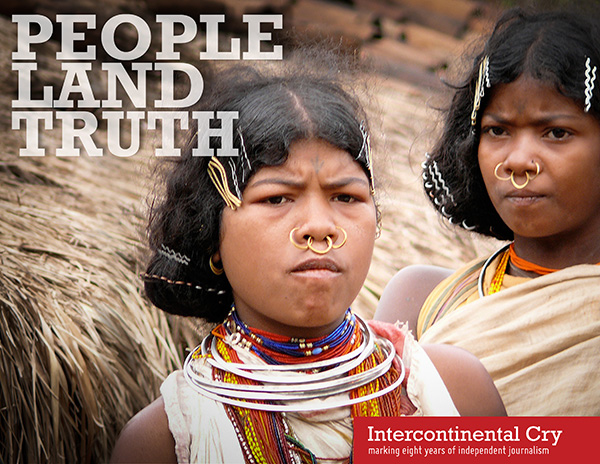
Intercontinental Cry (IC) is pleased to announce the release of People Land Truth, an anniversary eBook marking eight years of independent journalism for the global Indigenous movement.
West Papuan chapter from e-book "People Land Truth" below
---------------------------------------------------
PEOPLE LAND TRUTH
Our first major online publication, People Land Truth features more than three dozen stories, including 37 revised and updated articles from the website and some very generous contributions from the Indigenous Environmental Network and the Sacred Land Film Project.
You can download a copy of People Land Truth below. Print versions are also available for a $20 donation. Donations can be made through Paypal. If you're interested in obtaining several hard copies, please contact us for details.
DOWNLOAD
- Click here to download a copy of People Land Truth
Downloads: 92 (application/pdf)
---------------
Fear, Grief And Hope In Occupied West Papua
MARTIN PELCHER
The months of May and June have seen new waves of terror sweep through the troubled region of West Papua. Tens of “mysterious killings” have been reported, occurring mostly in the Papuan capital of Jayapura. Security guards, students, and soldiers have been shot dead; a woman’s mutilated body was found; and
a German biologist narrowly survived being shot in the chest at a popular beach. With worldwide coverage of these incidents, the Indonesian security establishment has manipulated the climate of terror to justify more intense repression of Papuan nationalist groups.
This campaign climaxed on June 14 with the assassination of Mako Tabuni, the vocal deputy chair of KNPB (West Papua National Committee) – an organization that has been at the forefront of mass mobilizations demanding a referendum on Papuan independence.
While advocates in the West have recently seen more success in terms of putting Papuan human rights on the international community’s agenda, this international visibility has been matched in Papua by the proliferation of forms of state terror. This increasingly tense situation may demand a re-evaluation of the work of international solidarity advocates.
(Not-so-)Mysterious Killings
The latest incidents in Jayapura have been shrouded in uncertainty and subject to wildly contrasting interpretations. Human rights activists in Jakarta and Jayapura, accustomed to seeing the hand of security forces behind such “mysterious” terror, have issued statements critical of Jakarta’s “security approach”, suggesting that the army and police are themselves responsible
for the violence. While these critical views have informed international news coverage, Indonesian news coverage has tended to give more space to police statements evoking shadowy “unknown persons” and pinning the blame on the student activists of KNPB as well as the wider network of underground Papuan nationalist resistance, OPM (Free Papua Organization).
Politically speaking, it is hard to see what Papuan nationalists could gain from inflicting public terror. Human rights activists have pointed out the professional aspect of the shootings, suggesting sniper expertise only available to elite state units such as Kopassus (Army Special Forces Commando) or Densus 88 (the Australian- and US- funded Police counter-terrorism unit). As with the fatal shooting ambush on a bus outside Jayapura last August, which took place the day before a major KNPB mass rally (itself timed to welcome a conference on Papuan independence in the UK), the latest killings appear to have been staged by powerful elements in the security forces so as to disrupt grassroots pro- independence mobilizations.
The recent episode also recalls the massive campaign of “petrus” (contraction of penembakan misterius, “mysterious shooting”) against so-called “criminals” in Jakarta, used by Suharto’s New Order regime to entrench its power in the 1980s. The police attributing the label “criminal” to KNPB leaders such as Mako Tabuni feeds a perception that Indonesian governance in Papua continues to employ a version of the “politics of fear” that sustained the New Order for so long.
The new petrus campaign in Jayapura, and the assassination has set the stage for, and has unfolded alongside other forms of terror. Just a week before Mako
Politically speaking, it is hard to see what Papuan nationalists could gain from inflicting public terror. Human rights activists have pointed out the professional aspect of the shootings, suggesting sniper expertise only available to elite state units such as Kopassus (Army Special Forces Commando) or Densus 88 (the Australian- and US- funded Police counter-terrorism unit). As with the fatal shooting ambush on a bus outside Jayapura last August, which took place the day before a major KNPB mass rally (itself timed to welcome a conference on Papuan independence in the UK), the latest killings appear to have been staged by powerful elements in the security forces so as to disrupt grassroots pro- independence mobilizations.
The recent episode also recalls the massive campaign of “petrus” (contraction of penembakan misterius, “mysterious shooting”) against so-called “criminals” in Jakarta, used by Suharto’s New Order regime to entrench its power in the 1980s. The police attributing the label “criminal” to KNPB leaders such as Mako Tabuni feeds a perception that Indonesian governance in Papua continues to employ a version of the “politics of fear” that sustained the New Order for so long.
The new petrus campaign in Jayapura, and the assassination has set the stage for, and has unfolded alongside other forms of terror. Just a week before Mako
PEOPLE LAND TRUTH IntercontinentalCry.org
|
Tabuni’s murder, an outbreak of brutality was triggered in the main highlands town of Wamena when two Indonesian soldiers on a motorcycle struck a Papuan child. After some local residents reacted angrily by stabbing the soldiers to death, the soldiers’ fellow troops from the notorious Infantry Battalion 756 “Wim Ane Sili” (local Dani language for “House of the Sound of War”) descended on the scene armed with bayonets and rifles, and unleashed a vengeful swath of destruction.
The attacks left several locals dead or injured, an entire village razed to the ground, and hundreds of Papuan residents displaced to the bush. Battalion troops then rampaged through Wamena town, burning regional government buildings and the homes of both indigenous Papuans and Indonesian settlers. In the aftermath of the violence, with many residents still in hiding, local human rights activists evoked the memory of the October 2000 incidents known as “Bloody Wamena” (Wamena Berdarah) – when deadly riots and a massive crackdown followed police attacks on posts flying the Morning Star flag of Papuan nationalism.1 In a Context of Fear, KNPB Mobilizes Recent events in Wamena have reflected tensions in Jayapura. KNPB is known to have an especially strong support base among students from the highlands region around Wamena who have settled in the coastal metropolis of Jayapura. Highlanders are often subject to especially severe forms of the racism that most Papuans face in the Indonesian urban context. Though KNPB’s mass mobilizations have been largely peaceful, stereotypes of violent and chaotic highlanders have been used to build fear of their politics via conspiratorial text messages presumably circulated by intelligence agents – a form of rumour that many Papuans refer to as “terror” (teror). In the face of fear and intimidation, KNPB has continued to mobilize, organizing mass protests to denounce the role of state security agents in creating the climate of terror.
In a press release days before Mako Tabuni’s death, KNPB suggested that state agents had played a role in the shooting of the German scientist, as a response to Germany’s criticism of Indonesia’s human rights record in Papua at a recent UN session.2
Security forces have responded to KNPB’s challenge with unrestrained aggression, deploying Barracuda mobile tanks and live fire against unarmed protesters, and arresting KNPB chair Buchtar Tabuni on his way out of a meeting at the provincial parliament convened by political leaders to discuss the deteriorating security situation. This is the volatile situation within which Indonesian forces (in this case, reports suggest it was Densus 88) have been able to eliminate a courageous and articulate voice of Papuan resistance.3 While Western governments periodically pay lip service to the importance of upholding human rights in Papua, one can guess at the deep (though surely unstable) complicities linking the interests of transnational capital, global governance institutions, and the military intelligence regime on Indonesia’s Pacific frontier zone.
65
The brutal crackdown underway against KNPB targets a group that has articulated a sophisticated anti-imperialist critique of the neo-liberal development policies being forced on Papuans by the Indonesian security
state, the global resource companies that help fund it (notably US mining giant Freeport MacMoran and British oil and gas giant BP), and the foreign governments and international institutions who occasionally criticize Indonesia’s human rights performance but who are hostile to Papuan challenges to the status quo of Indonesian sovereignty. This is the global context that enables multiplying forms of terror and allows for the assassination of Mako Tabuni.4 The latest wave of killings and repression has come at a moment when KNPB has been intensifying its regional outreach work, enacting a program for a “West Papuan Parliament” that would channel forms of direct democracy towards the goal of self-determination. The prospect of a politicized and mobilized |
PEOPLE LAND TRUTH IntercontinentalCry.org
|
66
What Kind of International Solidarity?
Given the complexity and volatility of the political situation, it is not clear what helpful role solidarity advocates can play. The Indonesian state and media do not hesitate to attribute signs of Papuan “separatist” agitation to the shadowy forces of a “foreign conspiracy” seen as responsible for East Timor’s independence. It is worth understanding Indonesian nationalist anxieties in their historical and geopolitical context: the Indonesian nation was founded when the then- revolutionary national army expelled Dutch colonialists from most of the archipelago after WWII; 15 years later, the military launched operations to chase the Dutch out of Western New Guinea as well (the Dutch finally retreated under US and UN pressure). At the time, the standard Indonesian nationalist narrative framed the incorporation of Papua as a question of opposing imperialism, and the West Papuan movement as colonial puppets.6 More recently, Western support for East Timorese independence – and signs of such support being extended to West Papua – have been easy to frame as vehicles for the West’s neo-imperial manipulation and pursuit of the region’s abundant mineral and petroleum resources. The more Western advocates succeed in focusing global attention on the plight of Papuans under Indonesian rule, the more the Indonesian security establishment can deploy the specter of a “foreign intervention” (like the UN’s intervention in East Timor) to mobilize Indonesian public opinion behind its harsh policing measures. The current moment poses a stark challenge to action- oriented observers: how to generate global solidarity against injustice in West Papua without strengthening the state’s pretext for terror? Part of the answer may lie in the spaces for exchange that are being generated through networks like Intercontinental Cry: spaces where actors engaged in different worldwide struggles for justice can share perspectives (ideally)
KNPB’S AUGUST 2 RALLY IN WAMENA. PHOTO MARTIN PELCHER
anti-imperialist network spreading throughout the regions of Papua is surely viewed with suspicion by both the Jakarta intelligence establishment and the international players with interests in the region. KNPB’s grassroots political mobilizations complement the higher-level manoeuvres of the leaders of groups such as WPNA (West Papua National Authority) and DAP (Papua Customary Council), who came together at last October’s Third Papuan Congress to declare the Federal Republic of West Papua (FRWP). As the Congress closed, police, army and intelligence units stormed the site, beating and arresting hundreds and killing several. The newly-proclaimed president and prime minister of FRWP, Forkorus Yaboisembut and Edison Waromi, remain behind bars along with Congress organizers and a growing list of political prisoners convicted of “subversion” (makar).5 |
PEOPLE LAND TRUTH IntercontinentalCry.org
|
unmediated by giant corporations, intergovernmental institutions, INGO culture, or unreflexive settler-colonial privilege.
To put in plainly: the international West Papua solidarity movement is in need of platforms for exchange that do not center the voices and perspectives of white people. Subject to numerous waves of colonization, displacement and militarization, West Papuans have political affinities with colonized, displaced, racially-deprived, and otherwise subjugated peoples at a global level. But the dynamics of history and geopolitics have produced a situation where mainly white NGO workers and human rights activists have largely monopolized international access to the scene of West Papuan resistance politics. Collaborations with leftists and rights activists in Indonesian cities have been key to the Papuan movement, as they were for East Timor; so have expressions of support by African-American and Pacific US legislators. Still, global Papua solidarity advocates have prioritized high-level lobbying towards Western powers, at the expense of possibilities for “South-South”/ intra-“Fourth World” networking. For Indonesia’s deep security state to lose its “anti-imperialist” pretext for repression, solidarity linkages need to bypass neo-colonial adventurist-activist gatekeepers (including this author) – agents of what Teju Cole (referring to the “Stop Kony” debacle) has called the “White Saviour Industrial Complex”.7 In the 1950s, when Dutch planners were forced to abandon their colonial project in Indonesia, they refocused their fantasies of “ethical” imperialism on the supposedly “blank slate” of Western New Guinea. These colonial agents framed Papuans as “primitives” requiring “development” before they could be allowed to govern themselves. The legacy of this history lives on in the Indonesian state’s colonization project, fed by media depictions of Papuans’ supposedly “backwards” life ways.8 Throughout this history, Papuans have consistently been imagined as objects to be governed by others, rather than as political actors struggling for dignity.
Transnational human rights advocacy has succeeded in getting the story of Papuan suffering out there on the global stage; but the spectre of Western intervention is also justifying and motivating the terror it seeks to stop.
Prevailing models of international advocacy may not be working for West Papua; they are easy for the security state to manipulate towards its own ends – which happen to suit other powerful global actors as well. Western-centric human rights champions need to consider making way for alternative paradigms of direct solidarity among colonized and displaced peoples. ____________________________________________________ 1. See “Indonesia: Investigate military attacks on villagers in Wamena, Papua”, Amnesty International, June 8 2012, http://www.amnesty.org/en/library/asset/ASA21/020/2012/en/1b64dac4-87d7-46c8-8950- f838afa35d87/asa210202012en.html. 2. See “German born tourist shot by “unknown persons” whilst on a beach in Jayapura”, http:// westpapuamedia.info/2012/05/31/german-born-tourist-shot-by-unknown-persons-whilst-on-a-beach-in- jayapura/ 3. Police have acknowledged that they killed Mako Tabuni. They have alleged that he was responsible for several shootings; and that he resisted arrest, was in possession of a gun and tried to steal an arresting officer’s gun. Eyewitness accounts tell quite a different story: of Tabuni being shot point blank while being pinned to the ground by a group of men in civilian clothes. 4. See footage of a speech by Mako Tabuni at a KNPB mass rally in Jayapura, in which he condemns the entanglement of Indonesian state power with foreign capital (in Indonesian): http://www.engagemedia.org/ Members/yerry/news/papua-mako-tabuni-funeral-2 5. See, for example, “Forkorus: International community must acknowledge the rights of the people of West Papua”, Jubi Online, http://westpapuamedia.info/2012/02/16/forkorus-international-community-must- acknowledge-the-political-rights-of-the-people-of-west-papua/ 6. For analysis of clashing Papuan and Indonesian nationalist historical narratives, see David Webster, “Narratives of Colonization, Decolonization and Recolonization in Papua”, http://activehistory.ca/papers/history-paper-3/ 7. See Teju Cole, “The White Savior Industrial Complex”, The Atlantic, March 21 2012, http://www.theatlantic. com/international/archive/2012/03/the-white-savior-industrial-complex/254843/ 8. Scholar Danilyn Rutherford has documented this imperial legacy and its effects: see her new book “Laughing at Leviathan: Sovereignty and Audience in West Papua” (University of Chicago Press, 2012).
67
|