AWPA -West Papua Update No 4/2026
27 July 2026
There has been no improvement in the human rights situation in West Papua. Military operations and clashes between the TPNPB and the security forces continues. In one incident which gained international attention, was the killing of American pilot Nicholas Gosselin by the TPNPB after landing at an airstrip in Balinggama village in the Yahukimo Regency. His aircraft was also burned. The aircraft was owned by Associated Mission Aviation (AMA), an aviation company owned by Catholic dioceses in Papua.
The TPNPB has claimed that the plane was carrying Indonesian troops into the area although the Indonesian military has denied that claim. A spokesman for the TPNPB Sebby Sambom, said the aircraft had violated their ban on civilian flights in the area which was a conflict zone. Human rights groups have condemned the killing. The TPNPB said they consider any civilian planes entering their areas of operations to be legitimate targets.
The ULMWP said in a statement that that " a number of photos and videos release over the past weeks clearly show Indonesian civilian planes, like the PT AMA plane Mr Gosselin was flying, being loaded with ammunition, weapons, and other military equipment. The evidence also shows Indonesian soldiers entering the planes to be transported to conflict zones like Yahukimo and Nduga".
Photos below from ULMWP webpage.


21 July 2026: the Indonesian army and police again using civilian aircraft to transport military personnel in Yahukimo
Military operation in Intan Jaya raises serious human rights concerns: Escalation of armed violence causes new civilian casualties and mass displacement
9 July 2026 / 5 minutes of reading

A large-scale Indonesian military operation conducted across the Agisiga, Sugapa and Hitadipa districts of Intan Jaya Regency between mid-May and late July 2026 was accompanied by a series of armed confrontations and alleged drone strikes, resulting in civilian casualties, destruction of civilian property and widespread displacement. The operation, reportedly launched to pursue local units of the West Papua National Liberation Army (TPNPB), was accompanied by numerous incidents affecting local indigenous communities in Intan Jaya.
Five civilians were reportedly killed and eight injured during armed clashes or security force operations in Intan Jaya between 17 May and late July 2026. Local human rights defenders documented the burning of a dozen homes and religious buildings, attacks on church personnel, as well as allegations of arbitrary detention and extrajudicial killing committed by security force personnel during the operation…………….
Indonesian human rights commission demands review of military operations over West Papuan deaths
Andrew Mathieson Published July 6, 2026

Indonesia's National Commission on Human Rights has called on the country's President, Prabowo Subianto, to conduct a review of security operations for possible new rules of engagement for military and security personnel deployed across West Papua.
The commission known in Indonesian as Komnas HAM says security operations should prioritise more of a humanitarian, rights-based approach through the conflict-affected area rather than relying on colonial repressive measures in the face of the West Papuan independence movement.
The appeal follows ongoing allegations Indonesian security forces have been involved in a series of targeted attacks on Papuan civilians in Intan Jaya Regency of the Central Papua province.
Speaking at a press conference held in the territory's largest city of Jayapura on Thursday, Papua office head of the commission, Frits Ramandey, said Komnas HAM had gathered information indicating the body of Papuan man Okto Tigau was found lying in Mamba village on July 1 in the Sugapa district of the Intan Jaya Regency after he had been reported missing two days earlier.
"The victim's body was found near the Rajawali Task Force military post in Habema, and bore several wounds to the chest and abdomen," Mr Ramandey said.
It was also alleged another three Papuans in Intan Jaya were killed in multiple shooting incidents over the past few days which ended the life of an unborn child, who died in the womb. The mother, Melkiana Duwitau, was said to be seven months pregnant, according to reports of an underground Papuan media outlet in the territory. Ms Duwitau and her unborn child were killed after she was allegedly struck by stray gunfire while inside her own home. The series of deadly incidents sparked public anger in Intan Jaya, culminating with widespread protests in which thousands of residents joined students on Friday calling on Indonesian authorities to conduct a thorough investigation of the shootings. The protesters reportedly carried the bodies of Ms Duwitau and her unborn child, who allegedly was delivered during emergency surgery at Intan Jaya Regional General Hospital after the mother was shot, back to the family's home.
Komnas HAM has documented at least seven violent incidents in Intan Jaya throughout the months of May and June. Among them was an explosion believed to have been caused by a grenade at St Paul Catholic Church in Nabuni Mbamogo on May 17 which injured four civilians, and a separate suspected grenade attack - allegedly dropped by a drone - in the Danggoa village in the Agisiga district on June 18 which wounded two civilians.
The commission also recorded an armed conflict between the West Papua National Liberation Army and the Rajawali IV military task force - a special Indonesian regional defence command - on June 27, also in Agisiga, where an Indonesian soldier was killed and three others were injured.
Gunfire also struck the vehicle of Reverend Yanuarius Yange Yogi, a priest in the Roman Catholic Diocese of Timika in Central Papua on June 29.
Separate shootings on the same day left two Papuans wounded in Titigi in the Sugapa district while Elianus Agimbau, a Protestant pastor with the Indonesian Evangelical Tabernacle Church, was killed in Kupia village in Agisiga.
Komnas HAM has condemned the alleged attacks on Papuan civilians, saying violence against the "non-combatant" Indigenous people cannot be justified under any circumstances.
"Any attack against civilians, whether during armed conflict or outside it, by state or non-state actors constitutes a violation of human rights, international humanitarian law and the rights to life and security," Mr Ramandey said.
He expressed condolences to the families involved, stressing that civilians must receive the highest level of protection. Mr Ramandey urged both Indonesian security forces and the West Papua National Liberation Army to exercise restraint and avoid actions that could spread fear, stigmatise communities or place innocent civilians at risk.
He also called on Indonesian authorities to ensure law enforcement and security operations are carried out professionally, proportionately and in accordance with international human rights principles.
Komnas HAM urged both central and regional governments to provide comprehensive assistance to victims, including medical and psychological care, while ensuring that civilians are not forced to flee their homes over violence. The commission have asked to hold an independent, transparent and thorough investigation into the killings and other acts of violence to ensure accountability and justice for the victims and their families. "Komnas HAM is treating these incidents with the utmost seriousness," Mr Ramandey said. "We are collecting information and will continue monitoring the situation in accordance with our mandate."
Fears for more conflict in West Papua after American pilot killed
Johnny Blades RNZ Pacific 3 July 2026
There are fears of yet another escalation in military conflict in Indonesia's Papua region after an American pilot flying a small aircraft into a remote airstrip in Highland Papua province was killed by West Papuan militants. The West Papua National Liberation Army, or TPNPB, has claimed responsibility for killing Nicholas F Gosselin after he landed a small aircraft in remote Sobaham District, Yahukimo Regency on Thursday. Gosselin had just flown seven passengers to Yahukimo from Wamena, Highland Papua's major town, in an aircraft which belonged to a small Indonesian airline, PT AMA. The militants also burned the plane.
Warning
The TPNPB has repeatedly warned foreigners not to fly into the region if they were working with Indonesia's military, who it is in a long running conflict with.
Eneko Bahabol, a human rights defender with the Papua Council of Churches who works in this remote region, said the other people on board were local Papuan villagers. He said they were understood to have escaped without injury.
He said it is widely known that Indonesia's military relied on small airlines in order to fly into remote airstrips in Papua's interior, where its bigger planes cannot land.
"We have seen the call from the TPNPB not to transport military personnel. We have followed this in every one of their releases, but we see that the companies and the pilots do not listen to it, and this applies to all pilots transporting military personnel," Bahabol said.
However, this is not the first case of the TPNPB burning planes which have flown into the highlands region, nor of targeting pilots. In February 2023, the TPNPB kidnapped a New Zealand pilot, Phillip Mehrtens, after he landed a small plane belonging to commercial airline Susi Air in Nduga Regency of Highland Papua. They freed him nineteen months later. The Indonesian military has reportedly denied that the AMA plane attacked on Thursday was used to carry troops…………………
A number of new reports/updates below below
Human Rights Monitor

HRM Report “No Safe Path Home” examines allegations of booby traps in West Papua
Human Rights News, Reports / Indonesia, West Papua / 1 June 2026
The 24-page research report “No Safe Path Home: A report examining allegations of victim-activated explosive devices in West Papua in light of Indonesia’s obligations under the Anti-Personnel Mine Ban Convention” analyses five documented incidents involving alleged anti-personnel mines, booby traps, and other victim-activated explosive devices in the Papua Tengah province and Papua Pegunungan province between 2023 and 2025. Drawing on witness accounts, visual documentation, official statements, and international legal standards, the report analyses the allegations in light of Indonesia’s obligations under the Anti-Personnel Mine Ban Convention and highlights concerns regarding treaty compliance, transparency, accountability, and civilian protection……..
TAPOL's 2nd Quarterly Update 2026
09 June 2026

Indonesia has not been immune to the currents affecting the world’s politics so far this year. It seems to be increasingly jumping on to the bandwagon with the US, eroding years of carefully-cultivated neutrality in the process. Meanwhile, the intimidation of activists has reached a new shocking milestone, with prominent human rights activist Andrie Yunus being attacked with acid, after protesting against increased military power in Indonesia. Yet, despite these moves by authorities, a coalition of human rights organisations, churches and sections of the national parliament are making increasingly loud calls for urgent action against abuses in West Papua. These efforts show that despite an atmosphere of pessimism felt across civil society, new actors are now adding their voices to a chorus crying out against injustice, showing that hope against abuses by those in power remains possible……………
https://tapol.org/news/tapols-2nd-quarterly-update-2026
Human Rights Monitor
General developments point to a contested and still-deteriorating outlook. Church leaders have explicitly linked the crisis to state policy, arguing that the development-through-security approach codified in Presidential Instructions No. 9 of 2017 and No. 9 of 2020 on the acceleration of development in the Papuan provinces has legitimised militarisation and deepened the humanitarian emergency in West Papua. the DGP’s demands an immediate halt to military operations in civilian areas, concrete civilian protection, unimpeded humanitarian access, an independent investigation into alleged rights violations, and access for foreign journalists.
The Papua Council of Churches (DGP) stated on 21 April 2026 that the humanitarian crisis can be traced back to late 2018, linked to escalating violence and intensifying military operations in civilian areas. These operation had reached alarming levels pointing at various incidents involving excessive police or military violence in the regencies Lanny Jaya, Intan Jaya, Puncak and Dogiyai between March and June 2026. IDPs continue facing dire conditions, including acute shortages of food, healthcare and protection, compounded by the encroachment of military activity into villages, churches, schools and markets that should be civilian safe spaces.
Papuan parliament members have repeatedly brought the humanitarian crisis in West Papua to the attention of the central government (see video below). On 7 June 2026, the West Papua National Liberation Army (TPNPB) publicly offered to guarantee humanitarian access for neutral organisations operating under the supervision of the International Committee of the Red Cross (ICRC). As of writing, Jakarta yet refuses to enter into a dialogue for a peaceful resolution of the conflict and continues to block humanitarian access to IDPs, as displacement in the conflict zones ware likely to climb so long as a security-driven approach prevails………….
Full update
Papuans Behind Bars 2025 Annual Overview
Papuans Behind Bars 15 June 2026
Full Report
https://papuansbehindbars.org/annual-overview-2025/
Summary
We recorded a total of 291 political arrests throughout the year. At least 233 of those arrested were released without charge, a few hours or days after their arrest. Forty people are reported to be facing further legal proceedings in a number of courts. At least 60 reported having been subjected to torture and other ill-treatment during their arrest or detention; five died.
According to the information we have received, the majority of those responsible for these arrests were police officers, accounting for 252 cases. Military personnel were involved in 22 cases. The remainder were carried out jointly by the police and the military.
Of the 30 who have been convicted, four were charged and convicted under treason laws. They were sentenced to seven months’ imprisonment at a court far from their hometowns and the location of the incident, the Makassar District Court. In addition to treason, ten were tried on charges of possession of sharp weapons or firearms, 11 were charged with embezzlement, two were charged with murder, and the remainder were charged with endangering public safety and disseminating digital content deemed to incite hatred. Only one of them was acquitted of all charges, because the defendant was a minor. The rest were found guilty, with sentences ranging from six months to 15 years.
By the end of 2025, 48 of the 291 people arrested were still in custody. Ten were on trial in various courts, 21 others were serving sentences in various prisons in West Papua, and the remainder were still being held for questioning by the police. In total, including those arrested in previous years, there are 63 people currently serving prison sentences and 38 people who are still being detained or, at least, have not yet been reported as having been released.
English version
Human Rights News / Indonesia, West Papua / 15 July 2026

A new Project Multatuli investigation, based on cross-verified troop mobilization data and internal TNI documents, finds that Indonesia currently deploys 74,297 soldiers in West Papua, including 17,780 non-organic troops rotated in from bases across Indonesia at an estimated annual cost of IDR 2.34 trillion (about € 113 million), spread across 31 of West Papua’s regencies in units such as the border security task forces (Pamtas), the mobile combat taskforce Satgas Mobil, elite Satgas Rajawali, and joint TNI-Polri forces guarding PT Freeport Indonesia’s mining operations.
Read new Multatuli Report here
Combined with police personnel, total security forces in the region reach 103,196. This figure results in a ratio of one officer for every 57 civilians, roughly six times higher than the national average. Compared to the estimated number of armed resistance fighters in West Papua, the government has deployed 72 security personnel for every estimated pro-independence militia member.
The report highlights Intan Jaya as one of the most militarized and violence-affected regencies, hosting 1,800 non-organic troops against roughly 300 militia members, it also documents disputed casualty figures from an October 2025 raid in Soanggama village. Local human rights defenders found elevn bodies after the operation, saying that only five of the executed victims were affiliated with the TPNPB. This fiunding strongly contradicts the military’s claim that all 15 persons killed TPNPB combatants.
Nationally, the report links the militarization to over 122,000 indigenous Papuans, who have been internally displaced by armed conflict over the past eight years, with roughly 60,000 people from Nduga alone. The report situates the current militarisation in West Papua within a longer historical pattern, beginning with the contested 1969 “Act of Free Choice” through repeated cycles of security-driven responses to Papuan political demands. Multatuli Project argues that the scale, structure, and territorial functions of the military presence, including its role in guarding extractive and infrastructure projects and performing civil governance tasks, constitute a pattern of military occupation rather than sincere law enforcement measures.

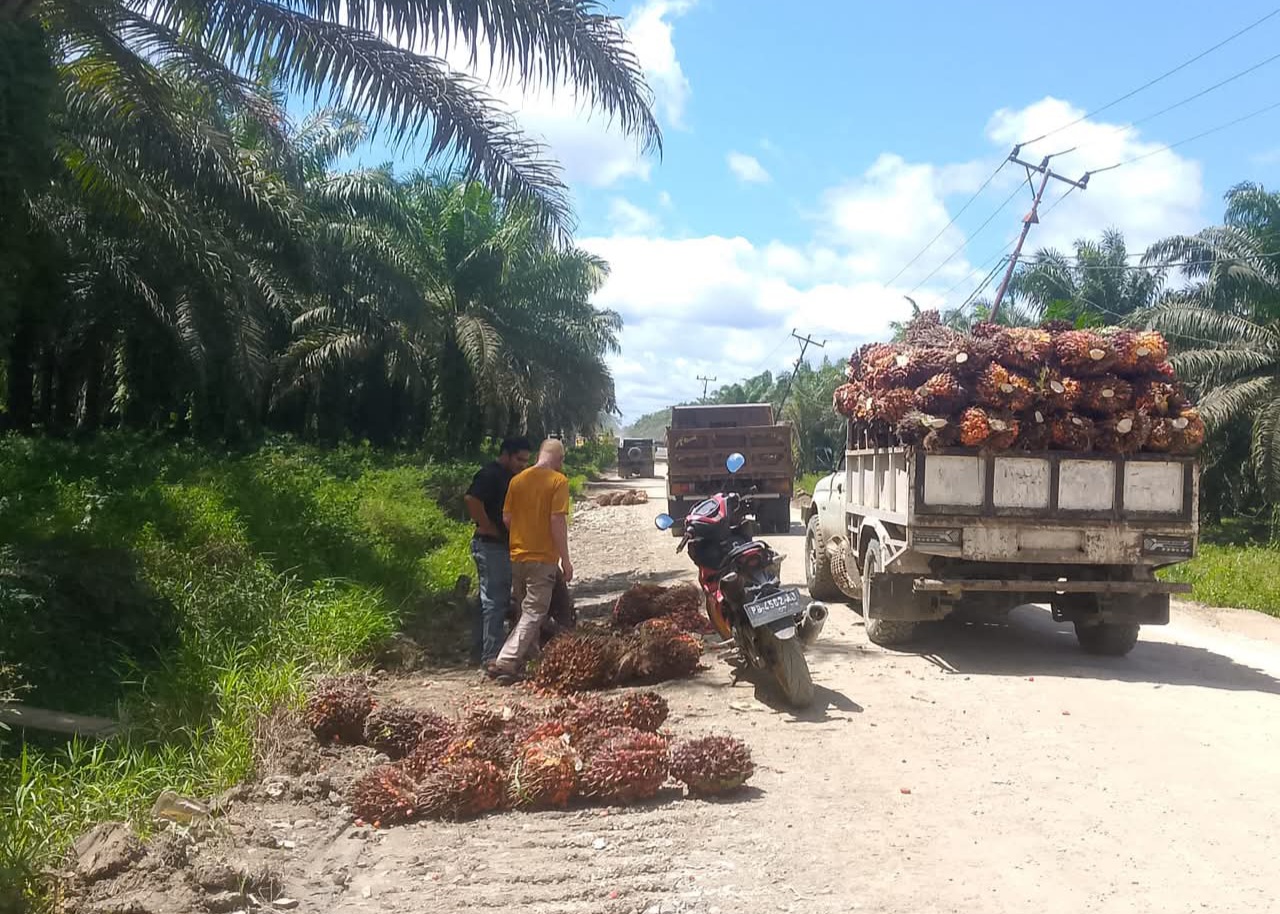
Sorong, Jubi – Residents in Sorong Regency, Southwest Papua, have protested against palm oil company PT Inti Kebun Sejahtera (IKS) for continuing to harvest palm fruit on land that remains under dispute in Klalik Village, Klaso District.
One resident, Roy, said the community was disappointed that the company had continued its operations despite ongoing objections from landowners. “Since January, we have maintained a blockade on the area as a form of protest because our concerns and rights have never been properly addressed. Yet the company continues to enter the disputed land and harvest palm fruit as if there were no problem,” Roy said on Sunday. According to Roy, the community initially agreed to allow the company to use the land for a nursery. However, residents later alleged that the company expanded its activities and converted the area into a palm oil plantation without obtaining consent from the customary landowners.
He said the dispute dates back to 2006, when the company began clearing land in several plots that formed part of community-owned plasma plantation areas. The clearing, he claimed, was carried out without prior notification to local residents who held rights to the land.
Roy said residents sought compensation of Rp150 million during mediation efforts held in February 2026. The figure was calculated based on the company’s use of the land from 2006 to 2025.
During negotiations, the community later reduced its demand to Rp250,000 per hectare per month for an agreed period.
“We have tried to find a compromise. Initially, we requested Rp150 million based on nearly two decades of land use. We later reduced our demand to Rp250,000 per hectare per month and even agreed to limit compensation calculations to the company’s operations between 2020 and 2025. However, our demands have yet to be addressed,” Roy said……………..................

The attempt to pit an actor and the filmmakers of the Pesta Babi against each other only proves that there is colonialism in Papua. It is a brazen divide-and-rule tactic.
THE police report filed against the filmmakers of Pesta Babi (Pig Feast) by Yasinta Moiwend validates the main thesis that forms the subtitle of this documentary: colonialism in our time. A primary characteristic of colonialism is the pitting of native people against each other, as was done by its most popular figures, Snouck Hurgronje in Aceh and C.C. Berg di Java.
Both were scholars dispatched by the Dutch colonial government to study the Nusantara (archipelago) in order to subdue it. Hurgronje was an anthropologist and Islamic scholar, while Berg was a philologist. Hurgronje’s research in Aceh birthed the divide et impera strategy that fractured the ulee balang (secular nobility) from the ulema. Meanwhile, Berg engineered the myth of historical enmity between the Sundanese and Javanese traditions through his analysis of the Bubat War.
The result of their “work” was a never-ending cycle of internal friction across the archipelago. Yet, what is happening in Papua today is far more barefaced than the divisive tactics of the Dutch colonial administration. In Papua, Mama Yasinta is being “used” to delegitimize the main message of Pesta Babi: how military operations and food estate projects are ravaging the region’s ecosystem.
A person who from the very beginning opposed the food estate project, a mother who fought to defend the customary lands as a living space, a woman who spoke out loudly about the critical importance of Papua’s forests for Indonesia, has suddenly turned around to dismantle everything she stood for. It is too vulgar to call the sequence of activities from when she lost contact with her family on May 24, 2026, visited an Indonesian Military (TNI) post, and then was flown on a private jet to Jakarta to report the activities of civil activists to the police a coincidence.
Mama Yasinta’s U-turn goes to show even more clearly that the food estate project in Papua is no trivial project. As well as being run by a company belonging to Andi Syamsuddin Arsyad, a tycoon close to President Prabowo Subianto, the project is being backed by the military and the police. This boundless state power is suppressing the voices of indigenous Papuans. Mama Yasinta is simply a devious tool to silence them.
Consequently, expecting the police to investigate allegations of intimidation against Mama Yasinta is a fool’s errand. The police are inherently part of the script to delegitimize the message of Pesta Babi. As both an actor in the documentary and an indigenous figurehead who symbolized resistance against the 2.7-million-hectare mega-project, Mama Yasinta is the perfect weapon to dismantle the barriers threatening President Prabowo’s flagship project. Food and energy self-sufficiency are Prabowo’s main programs. After the failure of a similar project in Central Kalimantan while he was Defense Minister, Prabowo shifted his attention to Papua. He has ordered his ministers to transform the wetlands of South Papua into paddy fields and convert forests into oil palm plantations to feed his biodiesel ambitions. The film Pesta Babi could become a stumbling block to achieving these goals.
In truth, Pesta Babi is neither the first nor the only journalistic work to expose the exploitation of Papua to the global community. A series of investigative reports by Tempo and the documentary films Dines Lingkungan (The Environmental Patrol) on YouTube had repeatedly brought these issues. Mama Yasinta even first came to public attention through an interview in this documentary.
Green Left
28 years since the Biak massacre, conflict in West Papua escalates

Indonesian security forces massacred scores of people in Biak, West Papua, on July 6, 1988. Victims included women and children who had gathered for a peaceful rally at the base of a water tower flying the Morning Star flag — West Papuans’ symbol of independence. According to a statement released by the Australia-West Papua Association (AWPA) on July 5, activists and local people had started gathering beneath the tower four days earlier, singing songs and holding traditional dances. As the rally continued, many more people in the area joined in with numbers reaching up to 500.
Although the Australian government knew about the massacre, it failed to condemn the Indonesian military for the atrocities, said AWPA……………..

West Papuan activists raise alarm over AI-generated deepfake videos
By Erwin Renaldi and Seni Iasona
Topic: Disinformation and Misinformation

In the deepfake video, Koteka Wenda speaks out against a controversial documentary she supports. (ABC News: Tri Ardhya)
When Koteka Wenda stumbled across an AI-generated video of her circulating on social media, she was shocked. In the video, she was speaking out against a documentary that has become the subject of fierce debate.
"The resemblance of my likeness is so sinister," she told the ABC.
"I felt like me and my people were violated." Ms Wenda is the daughter of Benny Wenda, the leader of the United Liberation Movement for West Papua. The deepfake video shows Ms Wenda criticising the 90-minute film Pig Feast: Colonialism in Our Time, or Pesta Babi in Indonesian. The film by Dandhy Dwi Laksono and Cypri Jehan Paju Dale exposes mass deforestation and indigenous land exploitation in West Papua, allegedly facilitated by the Indonesian government through national strategic projects and big corporations........................ https://www.abc.net.au/news/2026-06-21/ai-generated-content-targeting-west-papuan-activists/106760046
https://www.facebook.com/MelanesianSpearheadGroupSecretariat
July 25
MSG LEADERS' RESOLUTION PRESENTED TO THE UN HUMAN RIGHTS COUNCIL
The Melanesian Spearhead Group (MSG) Secretariat formally presented the Pacific and MSG Leaders' resolution for the Human Rights Commission to visit West Papua and the Papuan Provinces in Indonesia during the 19th session of the Expert Mechanism on the Rights of Indigenous Peoples (EMRIP) in Geneva, Switzerland.
EMRIP is a key advisory body of the UN Human Rights Council. Its role is to provide critical advice to the Human Rights Council on the implementation of the UN Declaration on the Rights of Indigenous Peoples (UNDRIP).
The activity was actioned in line with the Leaders' Mandate. During the 22nd MSG Leaders’ Summit held in Port Vila in June 2023, MSG Leaders supported the call made by Pacific Islands Forum (PIF) Leaders in 2019 for the UN High Commissioner for Human Rights to visit West Papua and the Papuan Provinces. The call was reiterated by Pacific Leaders in 2025 during the PIF Leaders' meeting in Honiara and the MSG Summit in Suva, Fiji.
The Acting Director General (ADG), Mr. Ilan Kiloe, said the MSG Secretariat’s engagement with the UN Human Rights Mechanisms is an important step in advancing the PIF and MSG Leaders' decision.
“It is a small but significant step towards the implementation of the leaders’ decision to advance the voices of Melanesian peoples on the international stage and demonstrates the organization's strong commitment to promoting justice, human rights, and the rights of Indigenous Peoples,” Mr. Kiloe said.
"The MSG Secretariat has championed advocacy on indigenous rights during the recently concluded ICJ Advisory Opinion on the obligations of states in respect to Climate Change, and we must continue to demonstrate that commitment," he added.
In addition to attending the EMRIP session, the MSG Secretariat held a number of targeted bilateral meetings, particularly with the Chairperson of the Expert Mechanism on the Rights of Indigenous Peoples (EMRIP), Ms. Valmaine Toki; the Special Rapporteur on Indigenous Peoples, Dr. Albert K. Barume; the Chief of the Indigenous Peoples & Minorities Section of the United Nations, Mr. Hernan Vales; and special representatives of the Committee on the Elimination of Racial Discrimination (CERD), UN Treaty Bodies, the UN Voluntary Fund, and the UN Youth Office.
The mission concluded with a formal briefing session with the MSG Ambassadors & Permanent Representatives to the United Nations (PRUNs) based in Geneva, Switzerland. The briefing was organized by the Vanuatu Ambassador to the UN in Geneva, H.E. Sylvain Kalsakau, and hosted by Ambassador Mere Falemaka in the PIF Permanent Mission conference room.
The MSG Secretariat team was led by ADG Kiloe and supported by Political Affairs Officer Richard Balkonan and Acting Programme Manager/Legal Officer Brittien Yosef.
Australia is letting its Indonesia relationship drift
Why the West Papua rebels are targeting the Catholic Church
TAPOL Statement on the Recent Killings of a US Pilot and Communities in West Papua
https://tapol.org/publications/tapol-statement-recent-killings-us-pilot-and-communities-west-papua
------------------------------------------

No comments:
Post a Comment
Note: Only a member of this blog may post a comment.