
Jayapura, Jubi – The Papua Coalition for Law Enforcement and Human Rights has suggested that Yasinta Moiwend’s recent objections to her inclusion in the documentary film Pig Feast: Colonialism in Our Time may be connected to an ongoing legal case before the Jayapura Administrative Court (PTUN).
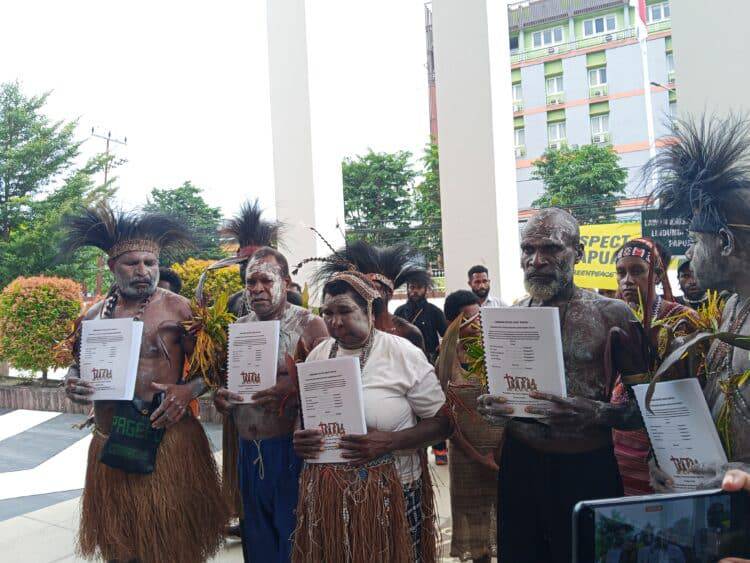
Previously, five representatives of the Malind Indigenous community, including Yasinta Moiwend, filed a lawsuit challenging Merauke Regent Decree No. 100.3.3.2/1105/2025.
The decree concerns the environmental feasibility approval for the construction of a 135-kilometer access road as part of a food security project initiated by Indonesia’s Ministry of Defense.
The case was registered with the Jayapura Administrative Court under Case Number 9/G/LH/2026/PTUN Jayapura on March 5, 2026.
The Papua Coalition for Law Enforcement and Human Rights, which is part of the legal team assisting the plaintiffs, stated that lawyers serving on the Merauke Solidarity Advocacy Team, acting as legal counsel for Yasinta Moiwend, cannot be subjected to criminal or civil liability for carrying out their professional duties.
“Yasinta Moiwend is a client of the Merauke Solidarity Advocacy Team, which is currently representing her in proceedings before the Jayapura Administrative Court,” the coalition said in a written press release issued on Wednesday (June 3, 2026).
According to the coalition, the advocacy team has been assisting Moiwend and four other Indigenous representatives in their lawsuit against the Regent of Merauke.
During the proceedings, Indonesia’s Minister of Defense entered the case as an intervening defendant. This was marked by the submission of the intervening defendant’s response to the panel of judges overseeing Case Number 9/G/LH/2026/PTUN JPR, which was filed on May 18, 2026.
The coalition stated that while the advocacy team was preparing its response to the Ministry of Defense’s submission, the public was surprised by the circulation of a video in which Yasinta Moiwend questioned the use of footage featuring her in the documentary Pig Feast: Colonialism in Our Time.
In the same video, Moiwend also stated that she would not travel to Jayapura to attend court hearings in the case.
“Taken together, these developments indicate that those who recorded and disseminated the video were clearly targeting the legal proceedings currently underway at the Jayapura Administrative Court,” the coalition stated.
The coalition further argued that because one of the statements in the video directly referred to the PTUN proceedings, the individuals who recorded and publicized the video had violated professional ethics by failing to coordinate with the Merauke Solidarity Advocacy Team, which remains Yasinta Moiwend’s legal representative.
“What is even more unusual is that, without any revocation of the power of attorney, the Director of LBH Papua Merauke was later reported to the Metro Jaya Police. In fact, the Merauke Solidarity Advocacy Team continues to hold legal authority as Yasinta Moiwend’s counsel in Case Number 9/G/LH/2026/PTUN JPR,” the coalition wrote.
The coalition argued that the police report against one of the leaders of an advocacy institution that is part of the Merauke Solidarity Advocacy Team contradicts Article 16 of Law No. 18 of 2003 on Advocates, which provides that advocates cannot be prosecuted civilly or criminally while carrying out their professional duties in good faith on behalf of their clients in court proceedings.
Based on that provision, the coalition stated that allegations made by Yasinta Moiwend against a member of the advocacy team, as well as actions taken by lawyers assisting her in filing reports with police authorities, should be reviewed by Indonesia’s advocate organizations in accordance with professional ethics procedures outlined in Article 8 of the Advocates Law.
The coalition also invoked Article 100 of Law No. 39 of 1999 on Human Rights in calling on the Papua representative office of Indonesia’s Judicial Commission to monitor the professionalism of the panel of judges handling Case Number 9/G/LH/2026/PTUN JPR.
The coalition urged the panel of judges at the Jayapura Administrative Court to conduct the proceedings professionally and impartially. It also reminded the Regent of Merauke and Indonesia’s Minister of Defense, who are defendants in the case, not to use the Yasinta Moiwend controversy to influence or gain an advantage in the ongoing legal proceedings.
In addition, the coalition called on the National Police Chief to instruct the Metro Jaya Regional Police to observe legal protections afforded to advocates and legal aid providers under Article 16 of Law No. 18 of 2003 on Advocates and Article 11 of Law No. 16 of 2011 on Legal Aid in relation to the Yasinta Moiwend case.
The coalition further urged the Honorary Council of Indonesia’s advocate organizations to immediately investigate alleged violations of the legal profession’s code of ethics related to the case.
The Papua Coalition for Law Enforcement and Human Rights, which provides legal assistance to the Malind Indigenous community, includes LBH Papua, PAHAM Papua, ALDP, KPKC Synod of the Land of Papua, JPIC OFM Papua, Elsham Papua, Yadupa, the Indonesian Legal Aid Foundation, LBH Papua Merauke, LBH Papua Sorong Office, KontraS Papua, and Tong Pu Ruang Aman. (*)
Jayapura, Jubi – The West Papua National Committee (KNPB) has emphasized that grassroots consolidation is essential to achieving the Papuan people’s right to self-determination.
The statement was delivered by KNPB Chairman Agus Kossay during the third anniversary celebration of KNPB Sentani’s Wenyana Yeik Sector, held together with the Papuan people in Sentani, Jayapura Regency, Papua, on Monday (June 1, 2026).
Kossay stressed the importance of building people’s power rooted in Papuan communities.
According to him, grassroots-level consolidation is a crucial step toward realizing the that right.
“People’s power is the primary requirement for liberating Papua from the state of military emergency and humanitarian crisis currently affecting the region,” Kossay said in a written press release on Tuesday (June 2, 2026).
Meanwhile, KNPB Sentani Regional Chairperson Sadrack Lagowan said activists within the sector had become increasingly mature in advancing the Papuan national struggle.
He stated that the third anniversary of KNPB Sentani’s Wenyana Yeik Sector should serve as an important reminder to strengthen efforts in organizing resistance, particularly within the Yahim area and its surroundings.
“To all activists in the Wenyana Yeik Sector and all community bases in Sentani, prepare yourselves for the national action that will be held this coming August,” Lagowan said.
According to him, organizational strengthening and coordinated efforts are needed throughout the preparation period from June to July 2026.
“This third anniversary is not only a reflection on the organization’s journey, but also an important milestone in the collective effort to fight for the fundamental rights of the Papuan people and to build solidarity in facing existing challenges,” he said.
The third anniversary commemoration of KNPB Sentani’s Wenyana Yeik Sector concluded with a group photo session and a communal meal as symbols of solidarity.
The celebration also served as an opportunity for KNPB Sentani to call for broader consolidation efforts aimed at expanding the Papuan people’s movement and strengthening activism in the Sentani area.
This year’s anniversary carried the theme, “Strengthen Activists’ Capacity, Expand the Wings of Resistance for the People Toward a National Civil Strike,” with the subtheme, “Through the Third Anniversary of the Wenyana Yeik Sector, We Are Determined to Strengthen Unity in Order to Realize a Democratic Revolution.” (*)
Jayapura, Jubi – The Dean of the Faculty of Mathematics and Natural Sciences (FMIPA) at Cenderawasih University, Dr. Henderite L. Ohee, M.Si., says that of the 35 fish species recorded in Lake Sentani, Jayapura Regency, Papua, more than half are now introduced or exotic species, including senhead fish (Channa striata) and flowerhorn cichlids.
“It is very alarming. Three months ago, fishermen caught a pleco in their nets,” Ohee said during the National Webinar on “Conservation of the Lake Sentani Ecosystem: Preserving Biodiversity Amid Environmental Change from the Perspectives of Academics, Researchers, and Policymakers” on Tuesday (June 2, 2026).
According to Ohee, the discovery is particularly concerning because it poses a serious threat to native fish species in Lake Sentani, including rainbowfish and the endemic Sentani gudgeon.
“Since 2013, I have been compiling fish data and identified 35 species. However, our latest research conducted between 2021 and 2024 found only 22 species remaining, of which more than 50 percent are introduced species,” he said.
Of the 22 species recorded, only nine are native, while 13 are introduced species, including flowerhorn cichlids and snakehead fish.
Ohee explained that one of the main causes of native fish decline is competition for food resources, particularly algae, between invasive species such as flowerhorn cichlids and native fish, including the Sentani gudgeon and the Red Rainbowfish.
“Flowerhorn cichlids reproduce very rapidly because they also feed on the eggs of Sentani rainbowfish,” he said.
“People may not have realized the consequences and simply released them from their aquariums. Once in the lake, they can spread, grow to a large size, and become a threat to the ecosystem,” Haryani said.
She noted that communities around Lake Sentani have long practiced a traditional conservation system known as burekheng, which helps protect and sustain native fish populations, particularly the Sentani gudgeon.
Burekheng, or sero, is a traditional fish conservation and harvesting method that has been practiced for generations by communities living along the shores of Lake Sentani.
“This local wisdom utilizes barriers or enclosures made from natural materials such as sago fronds and leaves to fence off sections of water where fish can be protected and raised,” she explained.
Haryani said the practice remains a valuable solution for preserving the lake’s ecosystem. However, she emphasized that maintaining water quality is equally critical to safeguarding native fish species.
The Head of the Papua River Basin Agency (BWS Papua), Dave H. I. Muchaimin, reminded regional governments that conservation areas must remain a priority when drafting district and provincial spatial planning policies.
He noted that sedimentation in Lake Sentani has worsened due to disturbances in forested areas and the Cyclops Mountains conservation zone, resulting from land-use changes that contributed to the 2019 natural disaster.
“Conservation areas must not be compromised. Lake Sentani is protected under numerous legal frameworks, including a Special Regional Regulation, and is one of Indonesia’s 15 national priority lakes,” he said.
Muchaimin also pointed to the narrowing of the Jaifuri River channel, which serves as Lake Sentani’s main outlet, attributing it partly to suspected illegal mining activities that have caused sediment buildup.
“I appreciate the Jayapura Regent for visiting the Anafre River area, where illegal mining operations have been using heavy equipment, including excavators,” he said.
The agency has also carried out reforestation efforts by planting eucalyptus trees and conducting clean-up operations to combat water hyacinth infestations in Lake Sentani.
“I agree with Dr. Henny Ohee that protecting the Lake Sentani ecosystem requires collaboration among all stakeholders, including local communities, NGOs, and schoolchildren,” Muchaimin added.
Professor Daniel Lantang warned that native fish species face a real risk of extinction, noting that the endemic Sentani gudgeon (Oxyeleotris heterodon) has become increasingly rare in local markets.
“I visit Sentani Market three times a week, and it is now very difficult to find native Sentani fish, especially the Sentani gudgeon,” he said.
Lake Sentani has already lost one of its most iconic species: the freshwater sawfish, which disappeared from the lake decades ago. The last recorded catch by local fishermen was in 1974.
The species became locally extinct due to overexploitation, environmental degradation, and the widespread use of gill nets.
Ohee further noted that Sentani rainbowfish populations are also declining. Two rainbowfish species found in the lake—the Sentani Rainbowfish and the Red Rainbowfish—are native to the ecosystem, with one being endemic to Lake Sentani.
According to Muchaimin, these rainbowfishes are commonly found at river moths around lake Sentani.
Another notable native species is the Sentani gudgeon (Oxyeleotris heterodon), known locally as kayaou. The fish is highly valued by communities around Lake Sentani and serves as the main ingredient in the traditional nutrient-rich dish Kha Ebhe Hele (Black Broth Sentani gudgeon). (*)
Jayapura, Jubi – Residents of Biak Numfor Regency, Papua, were recently shocked by a deadly explosion that occurred on Sunday, May 31, at around 2:45 p.m. local time. The blast was caused by what authorities believe was an unexploded bomb dating back to World War II.
CCTV footage from Biak Seaport captured flames, thick smoke, and a powerful explosion that rocked the area that afternoon.
The suspected wartime bomb exploded in the Fisheries Complex on Wolter Monginsidi Street, Fandoi Subdistrict, Biak Kota District, Papua Province.
The incident killed six people and injured 19 others, who were taken to hospital, damaged at least 10 homes, displaced 55 families, and drew international media attention, including coverage by the French news agency Agence France-Presse (AFP).
The explosion reportedly occurred when residents attempted to cut open the device to extract gunpowder, allegedly intended for use in illegal blast fishing operations.
Friction from a saw generated heat that ignited the explosive material, triggering a massive blast. At least 10 homes were damaged, several of them completely destroyed.
Older residents recalled that during the 1980s, fishermen in Papua—particularly in Biak and Jayapura—were believed to have used World War II-era explosives to catch fish in the waters of Humboldt Bay (Yos Sudarso Bay) and around Biak Numfor.
Speaking jokingly, he said local residents had even developed their own methods for dismantling bombs.
“People used to say that Japanese-made bombs had to be turned to the left to open them, while American-made bombs could simply be cut open with a saw,” he said.
Septinus also recalled a major bomb explosion that occurred in Jayapura during the 1980s, when several children from the Bhayangkara housing complex were injured by an explosion near Dok II, across from the Papua Governor’s Office.
According to him, former Persipura goalkeeper Elly Tiba suffered a permanent leg injury in the incident, although he remained able to walk.
At the time, an abandoned amphibious vessel from World War II sat rusting in front of the provincial government office.
“Children from Dok V and Bhayangkara often played and swam around the wrecked ship, which was a remnant of World War II,” he said.
One tragic day, a resident was reportedly sawing open a bomb inside the wreck when it suddenly exploded. Children from the nearby Bhayangkara complex became victims of the blast.
The explosion was considered one of the largest incidents of its kind in Jayapura, leaving many children injured.
Another area, Argapura Beach in South Jayapura District, became known as “Vietnam Village” because residents there were once widely associated with the use of explosives for fishing.
Many fishermen in the area reportedly lost limbs after accidents involving homemade fish bombs, locally known as dopis, which were often assembled using sulfur or explosive powder.
Papuan Paralympic athlete Marinus Melianus Yowei was also seriously injured in a fish-bomb accident. According to local accounts, he was preparing to throw a fish bomb into the sea but failed to release it in time, causing it to explode and injure him and several companions.
Similar fish-bomb explosions have continued to occur in recent years.
In April 2025, a 44-year-old man identified as Agus was killed in Abepura District, Jayapura City, when a fish bomb he was assembling inside his home exploded. The device reportedly used mortar-based explosive material.
Earlier, in March 2017, a resident of Abepantai, Abepura District, named Terry Wamuar, 47, died after a homemade fish bomb he was assembling exploded.
A similar incident also occurred at Base G Beach in North Jayapura District on December 12, 2007, killing Yeremias Wanggai, who was carrying the explosive device at the time.
His son, Manas Wanggai, then 15 years old, suffered severe injuries across much of his body and underwent intensive treatment at Dok II Regional General Hospital in Jayapura. (*)

No comments:
Post a Comment
Note: Only a member of this blog may post a comment.